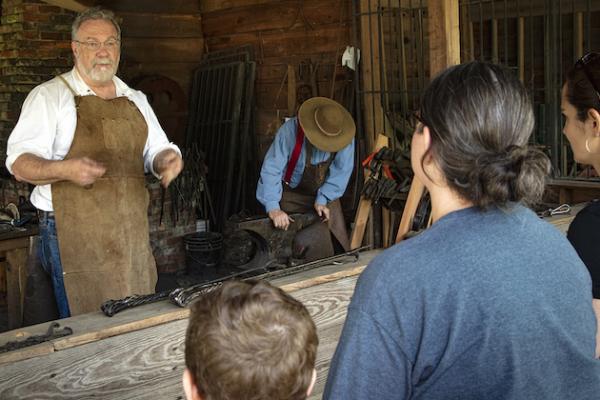
a man forges iron objects in front of an open fire
Travel Inspirations

Living History Sites

Discover places where history comes to life and learn what life was like in Colonial times
in North America.

States of Interest:
South Carolina
Living History Sites
Lancaster, SC

Programs and Guided Tours: Living history programs, including the Life of the Waxhaws Lantern Tour and the Andrew Jackson Birthday Celebration, are scheduled throughout the year. Please check our...

South Carolina
Living History Sites
Camden, SC

Offering visitors the opportunity to engage in history through demonstrations like blacksmithing or brickmaking, hearing our farm manager discuss 18th century agriculture, or touring our historic...

New Jersey
Living History Sites
Piscataway, NJ

Living Historians interpret the grounds and bring life to the park Wednesday through Sunday from the months of April to October. Keep an eye out for Continentals and Loyalists, who both make their...

South Carolina
Living History Sites
Mt Pleasant, SC

Exploring The Gullah Culture “Exploring The Gullah Culture” is a unique presentation where that difference can be experienced firsthand. Boone Hall is the only plantation in the Charleston area to...

South Carolina
Living History Sites
McConnells, SC

Learn how people farmed the land, cooked their food, and entertained themselves in the 18th and 19th centuries through interpreters in period clothing. These historical activities and others are...

South Carolina
Living History Sites
Blacksburg, SC

Visit the Living History Farm, a replica of a mid-19th century Yeoman Farm. The farm has a house, barn, cotton gin, farm animals, blacksmith and weave shop as well as a garden.

Filter By:
States of Interest:

Exploring History

We invite you to visit the preserved locations along the Liberty Trail and to immerse yourself in the extraordinary events that determined the fate of a nation.
Historic Site | Historic House
Bronx, NY

The Valentine–Varian House is a historic home located in the Norwood neighborhood of the Bronx. Site of skirmishes between British and American forces because of its commanding position over the Boston Post Road.

Historic Site |
Fort Montgomery, NY

Historic fort attacked on October 6, 1777, as part of the British army’s three-pronged invasion of New York.

Historic Site | Historic House
Roebuck, SC

Established in 1767 by the Patriot supporting Moore family. Local militia gathered at Walnut Grove prior to the Battle of Cowpens. Visitors may take guided tours of the house and grounds.

Battlefield
Johnsonville, SC

Known as an extremely important ferry crossing in the Colonial Period, Marion fortified this ferry and frequently utilized it to quickly move his troops to lay ambushes

Historic Site | National Park
New York, NY

Relocated Mansion of Founding Father, Alexander Hamilton.

Battlefield
Coosawhatchie, SC

In May 1779, British troops under Augustine Prevost advanced toward Charleston, prompting William Moultrie to withdraw as John Laurens rashly engaged at the Coosawhatchie River and was driven back with heavy losses.

Historic Site |
Crosswicks, NJ

New Jersey militia and Continentals assaulted a British column in-and-around these grounds in mid-June of 1778, just days before a continued series of skirmishes reached their zenith at the Battle of Monmouth.

Historic Site |
Schuylerville, NY

This property is located in the "Old Saratoga" unit of Saratoga National Historical Park.

Historic Site |
Somerville, NJ

This parsonage was constructed in the 1750s and housed the reverend of the Dutch congregation in what is now modern-day Somerville.

Battlefield | Historic Site
Summerton, SC

After an eight-day siege, this strategic outpost fell to the Americans, who used an ingenious structure called Maham’s Tower to fire down into the fort and trap the enemy.

Battlefield
Hollywood, SC

The Patriots launch a misguided attack on British troops retreating from an aborted raid on Charleston

Historic Site | Historic House
Princeton, NJ

A hidden gem in the borough of Princeton, the Bainbridge House was constructed in the mid-1760s and stands as a hallmark of colonial architecture. Today, it acts as a museum and interpretive center.