-
The BlogBiographies
-
Videos

When General Charles Cornwallis’s British army surrendered at Yorktown on October 19, 1781, it’s not like General George Washington went live on Instagram. News didn’t go out via tickertape or through the Associated Press. And no one, not even Alexander Hamilton, tweeted. Nope.
So how did news of the British surrender in Yorktown, Virginia make its way to Continental Congress in Philadelphia, Pennsylvania? News of the surrender had to be delivered—by hand—to the president of the Continental Congress, Thomas McKean. General Washington gave that important honor to one of his longest-serving aides-de-camp, Lieutenant Colonel Tench Tilghman. Tilghman left Yorktown on October 20 and rode for four days, arriving on McKean’s Philadelphia doorstep in the middle of the night, bearing a dispatch from Washington and bellowing for all to hear, Cornwallis is taken!
So if Tench Tilghman was the guy responsible for delivering the most important headline of the Revolutionary War, it’s remarkable that his name isn’t more celebrated amongst the annals of news carriers. Paul Revere got himself a poem for riding around warning The British are coming! You may be wondering why Tilghman didn’t get his own Longfellow-esque treatment. Well, I’m happy to tell you that he did.
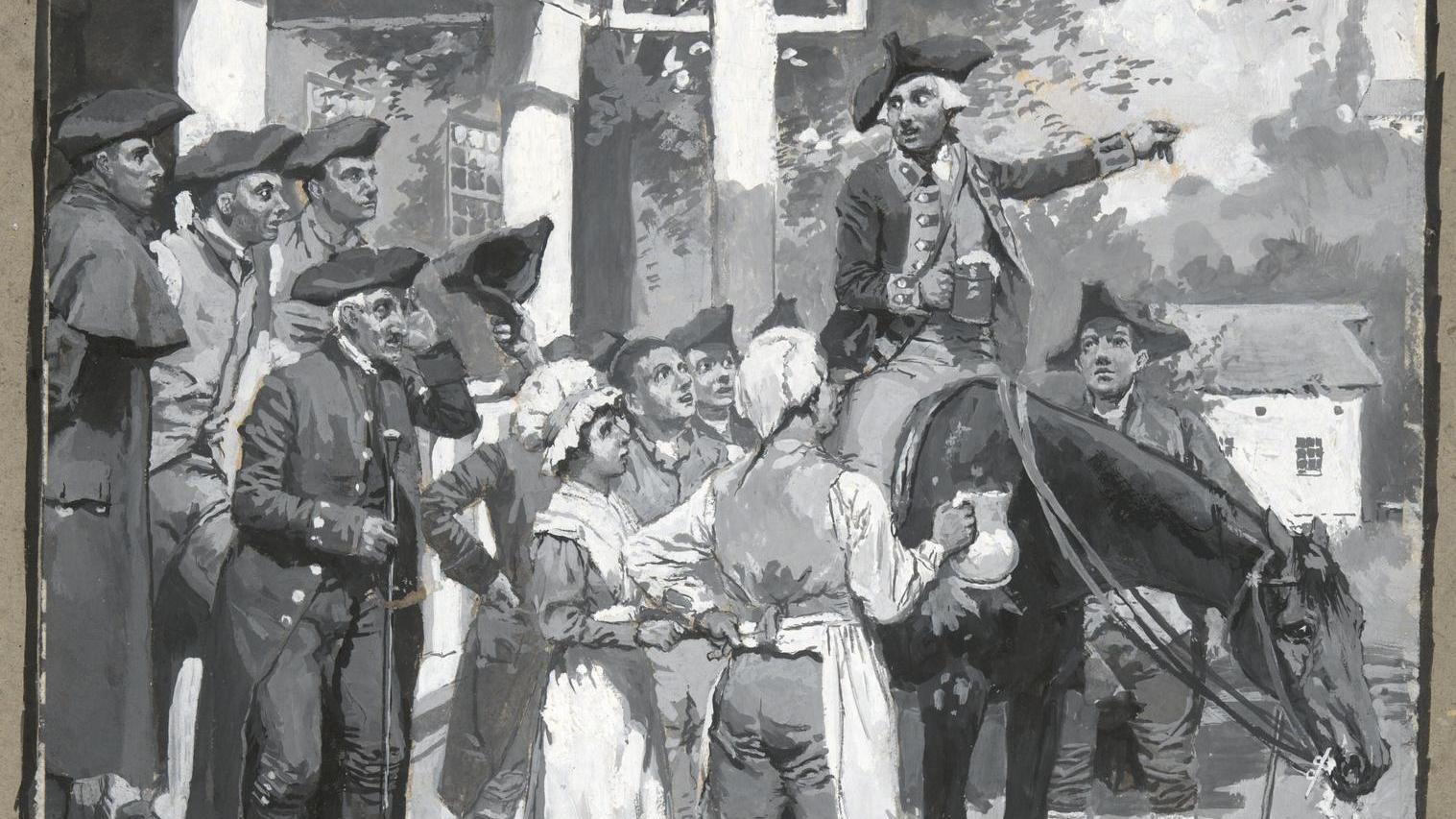
One hundred years after Tilghman’s (not so) famous ride, poet Howard Pyle’s “Tilghman’s ride from Yorktown to Philadelphia” appeared in the November 1881 issue of Harper’s Magazine. Pyle’s poem also included original art. Here’s just one:
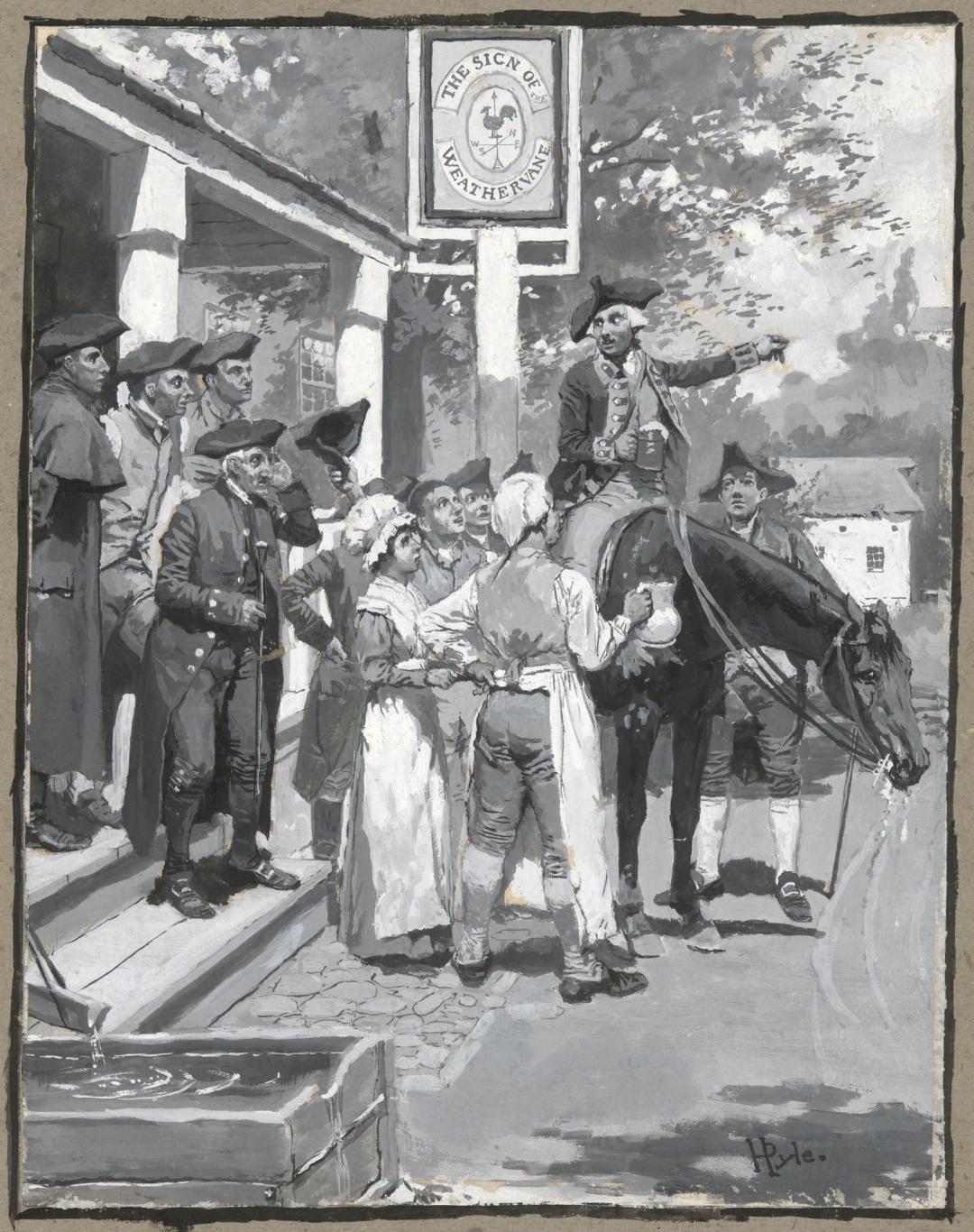
"He Stops at the Sign of the Weathervane," drawing of the illustration for the poem "Tilghman's Ride From Yorktown to Pennsylvania," by Howard Pyle, 1881.
"He Stops at the Sign of the Weathervane” depicts an apparently thirsty Tilghman stopping at a tavern and, still atop his steed, enjoying a foaming mug of ale while regaling those gathered ‘round with his good news. I mean, the guy had a week-long journey by boat and horseback, carrying the most important message of the war hundreds of miles away to Congress. Who wouldn’t need to stop for a pint?
But that’s not the only literary treatment bestowed upon Tench’s midnight(s) ride. Poet and Hamilton College professor Clinton Scollard penned “The Ride of Tench Tilghman” in his compilation Ballads: Patriotic & Romantic, published in 1916. It appeared alongside other poems eulogizing Revolutionary moments with titles like “The Drum of Lexington” and “Wayne at Stony Point.”
Scollard’s eight-stanza poem follows Tilghman from the moment of the British surrender and along his ride through the important city centers of the day, slinging his news like a sword and rousing the residents of Williamsburg, Alexandria, Baltimore and finally Philadelphia, where a sleeping John McKean meets Tench “in white nightcap and gown,” to hear the news “the world turned upside down.”
So consider this your cue to include the midnight(s) ride of Lieutenant Colonel Tench Tilghman alongside that of Paul Revere as you celebrate the heroism of those who carried Revolutionary news. And if you’re eager to learn more about Tilghman himself, we’re working on something really special to bring his story to life. This is Kate on The Liberty Trail--stay tuned for more.
P.S.: Read Clinton Scollard's poem here: THE RIDE OF TENCH TILGHMAN [OCTOBER 17, 1781] by CLINTON SCOLLARD - Poetry Explorer - Your Free Poetry Website for Classic and Contemporary Poetry
We invite you to visit the preserved locations along the Liberty Trail and to immerse
yourself in the extraordinary events that determined the fate of a nation.