-
The BlogBiographies
-
Videos

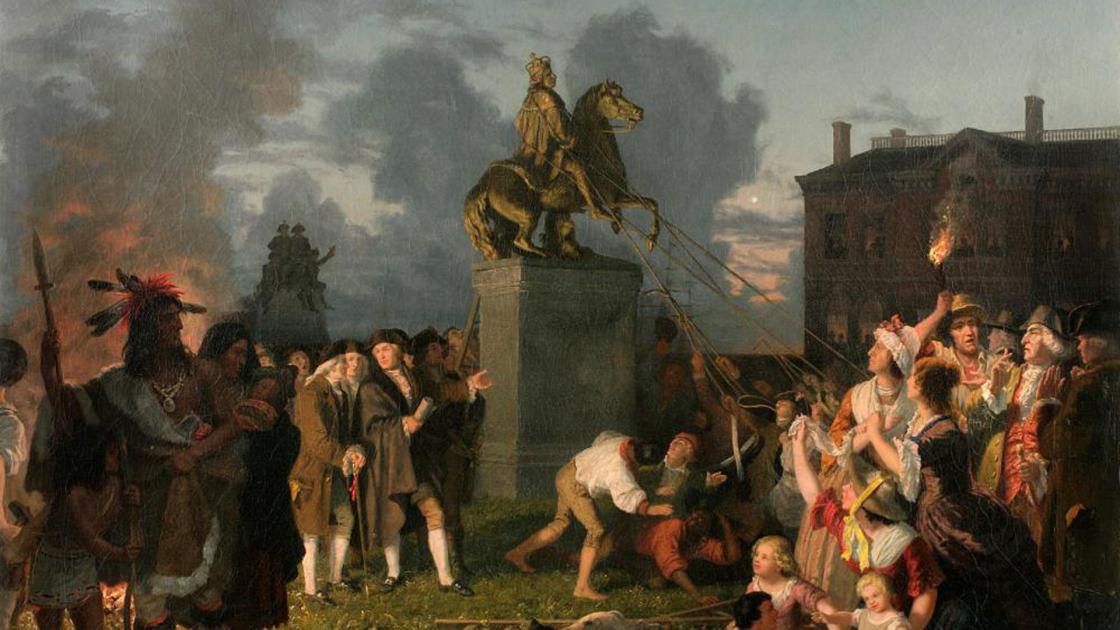
“The Declaration of Independence, which had been solemnly adopted by Congress on the Fourth of July, 1776, was announced to the army in general orders, and filled every one with enthusiastic zeal, as the point was now forever settled, and there was no further hope of reconciliation and dependence on the mother country.” ---Memoir of Colonel Benjamin Tallmadge, published 1858
It was August of 1776. General George Washington had only weeks before ordered a reading of the Declaration of Independence to his assembled troops in New York City. The words lit a fire under Washington’s near-mutinous, poorly-supplied, and underpaid Continental Army. His miserable troops in Manhattan now had a rallying cry—and toppled down the nearby lead statue of King George III to prove it. That moral boost couldn’t have come at a better time. Just off the shores of Staten Island, the British assembled the largest expeditionary force the world had ever seen. Hundreds of ships lay in wait, full of professional soldiers. To one colonist, it felt that “all of London” was afloat. This force of 20,000 eyed one target: New York City.
Washington’s Continental Army had sat in New York City since March after finally expelling the British from Boston. Washington hoped to keep the British at bay here, but British Generals William Howe, Henry Clinton, and Charles Cornwallis had other plans: take New York City and hopefully, end the rebellion all together. A contingent of the feared Hessians under General Leopold von Heister showed the British meant business. The British forces are close to 32,000 strong to Washington’s 18,000. But Washington doesn’t know just how outnumbered he is. Attempting to anticipate Howe’s plans, Washington divided his army into two lines, one at Gowanus Heights and the other at Brooklyn Heights, leaving the Jamaica Pass vulnerable and open. After secretly moving soldiers to flank patriot positions, the British launched their attack on August 27. Washington watched the whole tragedy unfold from the top of nearby Cobble Hill.
The Battle of Brooklyn was a British victory, but the patriot’s morale had never been higher. It’s been said that the Declaration of Independence was signed in ink in Philadelphia, and signed in blood in Brooklyn. The soldiers who fought here had something worth fighting for, as the words of the Declaration of Independence echoed as loudly as cannon fire.
Now it’s your turn to follow General Washington and his inexperienced troops in their first major battle of the American Revolution after the signing of the Declaration of Independence. Just like Washington’s troops did weeks before the battle occurred here, listen to the words of the Declaration of Independence. Get fired up. You’re on The Liberty Trail.
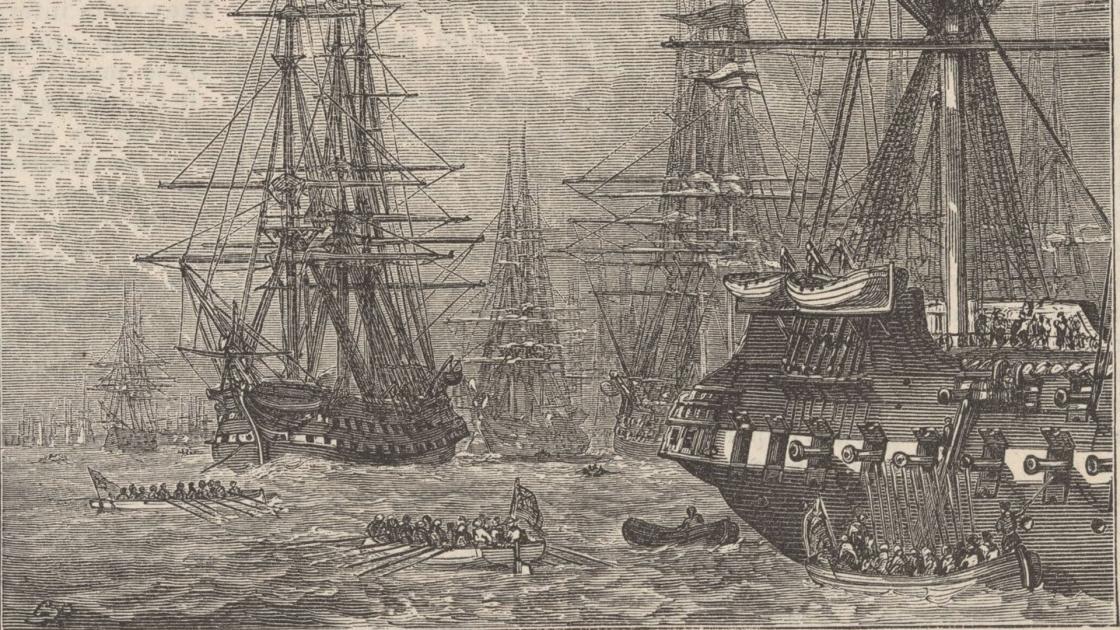
Historic depiction of the British fleet in the Lower Bay of New York.
Park on the street nearby and walk into John Paul Jones Park. Find the historic marker noting the site where Patriots made the first resistance to the British in 1776. You can walk down to the Bay Promenade to take in the view of the Narrows between Staten Island and Brooklyn and Gravesend Bay to the left.
Your tour starts here as you enter John Paul Jones Park, named for the Revolutionary War patriot and naval hero. Ironically, the Continental Navy is exactly what General George Washington didn’t have here. And it would have helped, too, because the battle that waged here happened in large part because Washington’s forces were unable to stop the British from landing at Staten Island here in late June. As hundreds of British ships approached, some say at least 400, Maryland private Daniel McCurtin thought “all London was afloat.” And on August 22, 1776, those forces landed here, having sailed up from Staten Island. Though the patriots had some minor defensive works, they were no match for the over 20,000 British troops that now threatened Washington’s mix of Continental and militia forces, many of whom had never seen battle. And Washington, unsure of where the British would strike their blow, decided to divide his forces between Manhattan and Long Island.
Your next stop takes you to where the British put their plans in action. Before you go, walk down to the Bay Promenade to take in the view of the Narrows between Staten Island and Brooklyn and Gravesend Bay to the left. Waterways were the highways of the eighteenth century. While much of Brooklyn’s landscape has changed significantly over 250 years, from here you can still see the waterways that influenced the battle that took shape here.
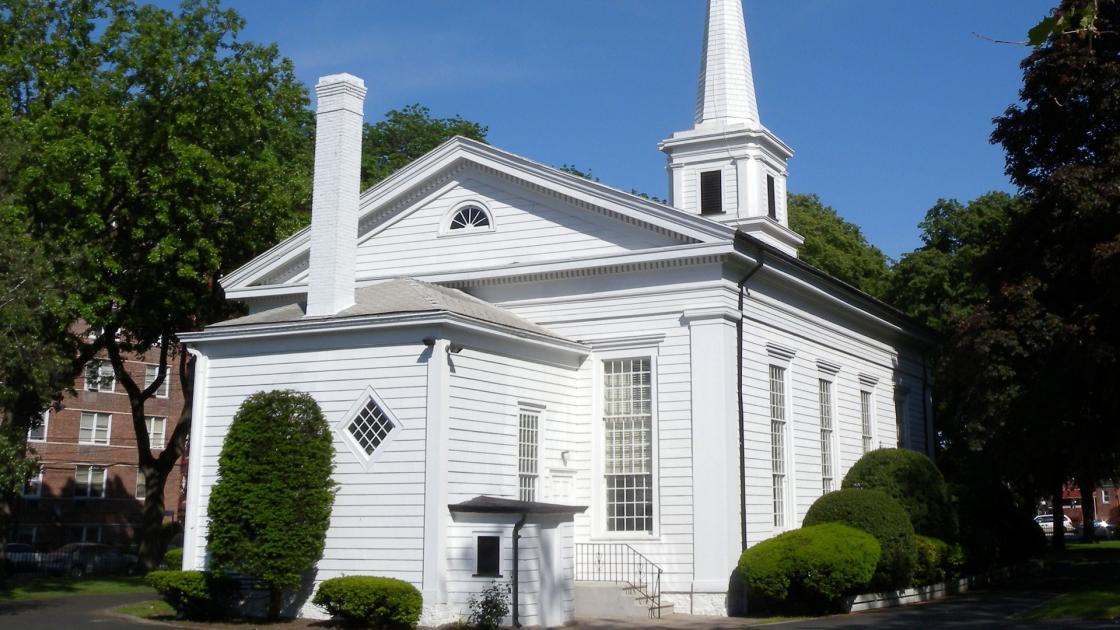
Eastern view of the Flatlands Reformed Church, the third structure to occupy this land since 1663.
Park on the street nearby and walk towards the churchyard until you find the plaque along Kings Highway. The church in front of you does not date to the battle. It was built in 1848, the third to occupy this site since 1663.
Kings Highway still follows the historic, eighteenth-century road that passed by here. It was a historic route even before the night of August 26, 1776, when British General Charles Cornwallis silently led his troops to pass by here. Their plan? Outflank General George Washington’s patriots. But silence and secrecy tonight was the key to British General William Howe’s strategy for tomorrow, when he planned to attack Washington’s defenses on the Gowanus Heights. But this night, the British column, stretching nearly two miles long, marched silently on their way to Jamaica Pass, which Washington left relatively undefended. Another British tactic in play here was diversion. General Howe had another trick up his sleeve. While 10,000 British soldiers marched 10 miles around the American flank, he secretly sent another detachment to the patriot right and center.
Washington knew something was afoot, he just didn’t yet know what. He addressed his troops:
“The enemy have now landed on Long Island, and the hour is fast approaching in which the honor and success of this army, and the safety of our bleeding country, will depend. Remember, officers and soldiers, that you are freemen, fighting for the blessings of liberty, and slavery will be your portion, if you do not acquit yourselves like men.”
The British troops were on their march. Your next stop follows in their footsteps.
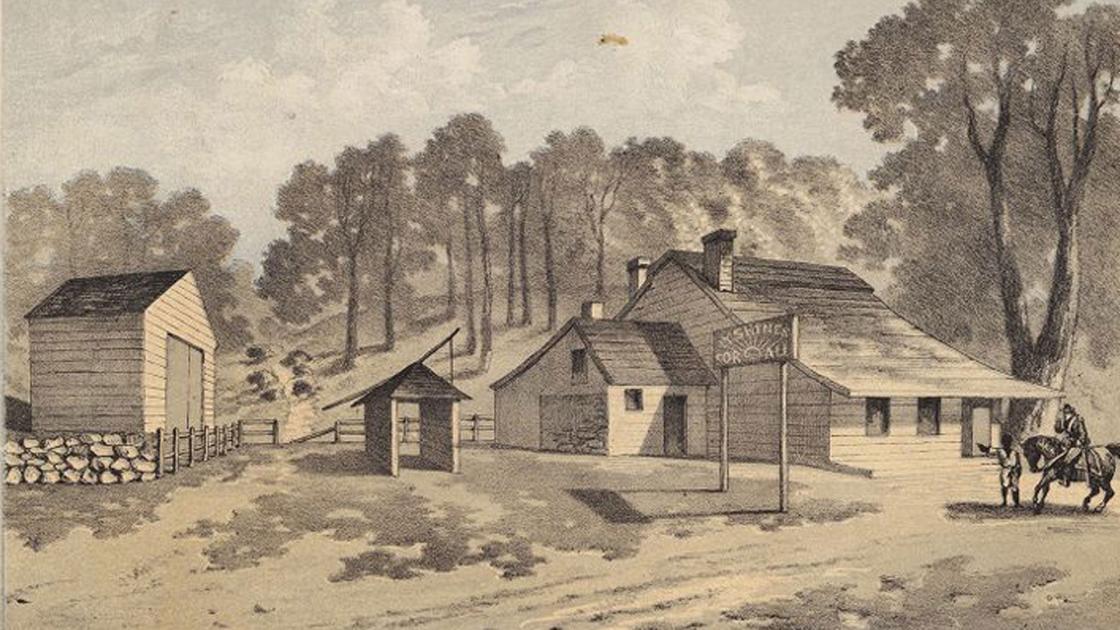
Depiction of William Howard's Tavern.
Park in the cemetery and find the sign to the old Rockaway Footpath. The boulder near the sign tells you more about the path’s significance, which predates the establishment of the cemetery in 1849.
Strip away the monuments and tombstones that surround you and imagine this site as it was 250 years ago, which soldiers described as a “bald hill.” In the early morning hours of August 27, 1776, the British were aware that only 5 patriot militiamen guarded Jamacia Pass, the easternmost pass on the Gowanus Heights where the British hoped to attack General George Washington’s troops. As thousands of British soldiers continued their silent march, they approached a tavern that stood near here close to the intersection of Broadway and Jamaica Avenue, and awoke its proprietor, William Howard. According to his testimony years later, Howard recounted that at about two o’clock in the morning, a man with a civilian’s hat and cloak appeared at his door asking for something to drink. The man revealed himself to be the British General William Howe and, along with General Henry Clinton, informed Howard that he was now their prisoner, and he must lead the army “across these hills out of the way of the enemy, the nearest way to Gowanus.”
At gunpoint, the British forced William and his 16-year-old son to lead the way along this meandering path down to present-day Moffatt Street and Central Avenue, where they easily overtook the 5 patriot guards. By daybreak, 10,000 British soldiers stood firmly on the patriot left and rear, beginning their march west towards the Americans. Reaching the village of Bedford, the British fired a two-gun signal. With the silence broken, the Americans knew they had been flanked.
William Howard, the tavernkeeper who was forced to escort the British army through the pass on the Rockaway Footpath, is buried here in Evergreens Cemetery. From his burial site on Beacon Hill, you can look out over the Brooklyn Flatlands and Jamacia Pass.
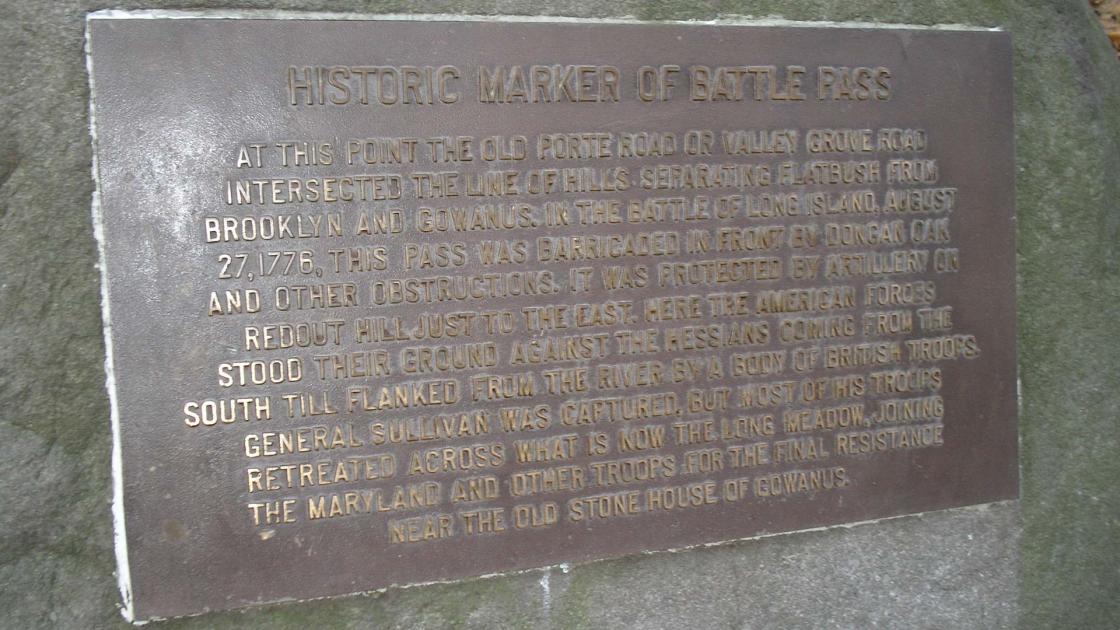
Park nearby on Flatbrush Avenue and walk into the park. Inside the park on East Drive are three markers: one on a boulder marking the American line of defense, one marking the Battle Pass, and the other denoting the location of the Dongan Oak tree, which patriots cut down to create a barricade to stop the enemy forces.
The large boulder markers you encounter on your walk denote the line of the American defenses that extended through what is now Prospect Park. This was the center of the American position. Look for the boulder marking the Battle Pass. This point of entry along the defensive line was guarded by Patriot General John Sullivan. In the early morning hours of August 27, 1776 Sullivan and his men were completely overwhelmed by a detachment of Hessian troops under the command of General Leopold von Heister. Sullivan’s men held their ground as long as they could, but Sullivan soon became aware of the approach of British troops coming up from the Jamaica Pass. They were surrounded. General Sullivan ordered his troops to retreat to Brooklyn Heights, but von Heister’s Hessians engaged the patriots in vicious hand-to-hand combat with bayonets. Here was some of the bloodiest fighting of the battle, and Sullivan himself was captured before he could retreat. Some of the patriot casualties of the Battle of Brooklyn are buried west of the park.
Continue to explore the park to get a sense of the pass and the landscape that patriots fought through here. As you do you’ll see many more monuments to the soldiers who fought here. Almost from the beginning of Prospect Park’s creation, New Yorkers have commemorated the battle that waged here. At the base of Lookout Hill is a monument to “The Maryland 400,” dedicated in 1895 on the anniversary of the battle by the Maryland Society of the Sons of the American Revolution, with 20,000 people in attendance. While this is not the location where the Marylanders fought, the monument reads “In honor of Maryland’s Four Hundred, Who on this Battlefield, August 27, 1776, Saved the American Army.”
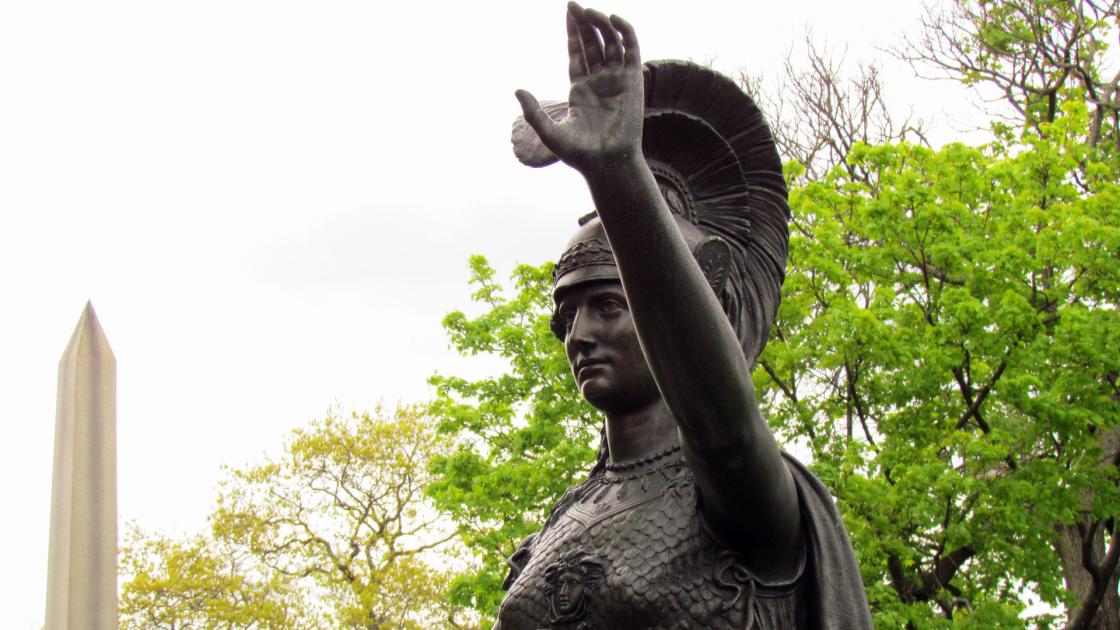
A statue of Minerva stands in Green-Wood Cemetery near where Lord Alexander Stirling faced British forces.
Park in the cemetery and follow the signs to the top of Battle Hill. Explore the historic markers, plaques, and a monument of the Altar of Liberty and statue of the goddess Minerva.
The first shots of the Battle of Brooklyn occurred not far from here in the early morning hours of August 27, 1776. Atop this hill patriot General William Alaxander (Lord Stirling) prepared his men for battle. Referencing British General James Grant’s boast to Parliament that he could march across the colonies and take down the rebellion with only 5,000 men, Stirling insisted “We are not so many, but I think we are enough to prevent his advancing farther over the Continental than this millpond!” With that, Stirling marched his 1,600 men toward the 7,000-strong British contingent, including those under General Grant. What followed was a 6-hour fight and a harried patriot retreat. One patriot soldier recalled the action, writing later:
The enemy then advanced towards us, upon which Lord Sterling, who commanded, immediately drew us up in a line, and offered them battle in the true English taste. The British army then advanced within about three hundred yards of us, and began a very heavy fire from their cannon and mortars, for both the balls and shells flew very fast, now and then taking off a head. Our men stood it amazingly well; not even one of them showed a disposition to shrink… Our men fought with more than Roman virtue, and would have stood until they were shot down to a man.
Stand under the shadow of Minerva, the Roman goddess of strategic warfare, and follow her gaze out into New York Harbor as she salutes the Statue of Liberty. From here, it’s important to remember that in August 1776, no one knew the long cost and toll of the American Revolution. And certainly no one knew that 250 years later this battlefield-turned-cemetery would become a place to remember the sacrifices of America’s patriots. If you’re lucky to be here in the fall or winter, the leaf-bare trees in front of you won’t obscure your view of the Manhattan skyline and New York Harbor.
Your next stop orients you to the opening shots of what would become the Battle of Brooklyn—the largest battle of the American Revolution.
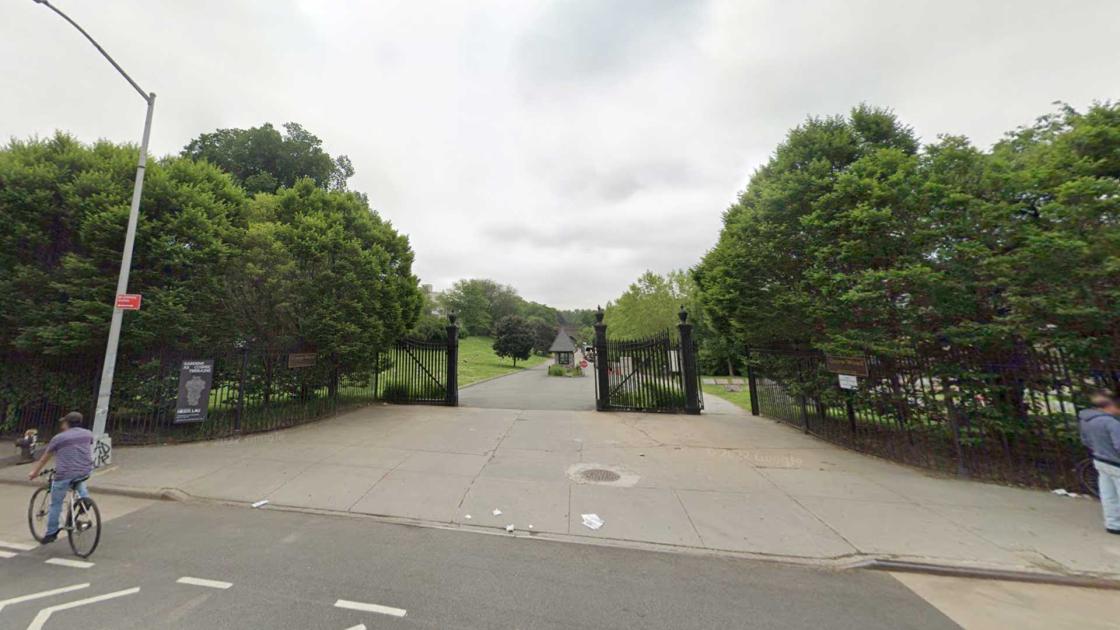
A watermelon patch once occupied the area near this gate.
Park on the street and walk through the cemetery gates. On your right is an interpretive marker about the Red Lion Inn and a monument to the Delaware soldiers that fought in the Battle of Brooklyn.
Instead of a paved walkway, imagine what is sprawling before you is a vast watermelon patch. That’s what a few British soldiers discovered here illuminated by the light of a full moon on the evening on August 26, 1776. But it wasn’t just watermelons here in the field. Here near the site of where the Red Lion Inn once stood, pickets of Pennsylvania rifleman caught British soldiers in the act of foraging around 10:00 p.m. Shots fired. A skirmish ensued. General George Washington now knew that British General James Grant was moving his contingent of the British Army up the Gowanus Road toward the patriot position.
Now is a good opportunity to pause and remember that for many of Washington’s troops, the battle that was about to unfold would be their first. Patriot Lieutenancy Benjmain Tallmadge was just 22 years-old, and had only recently left his life as a schoolteacher to, in his words, “take up the sword in defense of my country.” But he had no idea what was in store here at Brooklyn, and what that defense might really mean. In his memoirs Tallmadge wrote of the battle here, “This was the first time in my life that I had witnessed the awful scene of a battle, when man was engaged to destroy his fellow man. I well remember my sensations on the occasion, for they were solemn beyond description, and very hardly could I bring my mind to be willing to attempt the life of a fellow creature.”
Your next stop takes you from a humble watermelon patch to the scene of the hardest fighting of the Battle of Brooklyn.
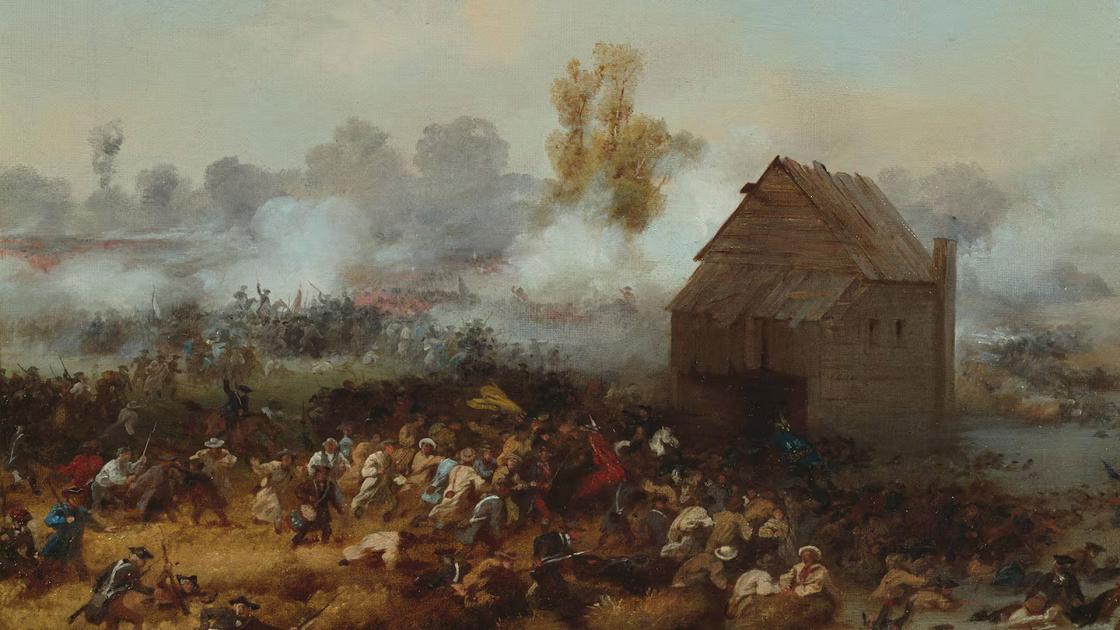
This mid-19th century depiction of the Battle of Long Island marks the spot where Lord Stirling and the 400 stood via gunpowder smoke.
Park on the street and walk through the modern park to find the Old Stone House. This is an early 20th-century reconstruction utilizing some of the material from the original Vechte-Cortelyou House constructed here in 1699. The house is now a museum with exhibitions and more information related to the Battle of Brooklyn.
“[the] only Chance of Escapeing being all made prisoners, was to pass the Creek near the Yellow Mills, and in order to render this the more practicable I found it Absolutely Necessary to Attack a Body of Troops Commanded by Lord Cornwallis posted at the House near the Upper Mills.”
- General William Alexander (Lord Stirling) to General George Washington, August 29, 1776
Today you are standing in a peaceful public park, but in 1776 this was the scene of the hardest fighting, the most casualties, and greatest bravery and sacrifice of the Battle of Brooklyn. At the dawn of the battle on August 27, the original Old Stone House, known then as the Vechte farmhouse, served as Patriot General William Alexander’s (Lord Stirling) headquarters. But hours later it fell to British General Charles Cornwallis and his vanguard as the patriots retreated to their main defenses. Surrounded by the British, Stirling knew they needed to cross the Gowanus Creek to the safety of the patriot lines, but the British nipped their heels and, assaulting the British here could mean more time for the patriots to cross the creek. Stirling asked that Major Mordecai Gist and 400 Marylanders to make the ultimate sacrifice: assault the over 2,000 British soldiers deployed here. Hardly any of the soldiers had seen battle before now, but it was up to them to save the patriot army.
Over and over, Gist led the young, untested Maryland 400 to charge the 2,000 seasoned professional troops, which included fierce Hessians and members of the 71st Regiment of Foot, Fraser’s Highlanders. When it was all finished, over 250 Marylanders were killed or captured, like 20-year-old Corporal William McMillan, who had only enlisted a few months prior. Over 50 years later, William relived the heat of battle in his pension application, remembering that “my Captain was killed, first lieutenant was killed, second lieutenant shot through the hand, two sergeants were killed, one in front of me. Same time my bayonet was shot off my gun.” William endured capture by the Hessian troops, who he remembered “broke the butts of our guns over their cannon and robbed us of everything we had, lit their pipes with our money…gave us nothing to eat for five days.”
The Maryland 400’s stand against the British was devastating, but it allowed much of the American forces to retreat. Lord Stirling himself was not among them. One Marylander who made it successful across the Creek later wrote, “General Stirling on this retreat was missing, whose brave example had encouraged and animated our young soldiers with almost invisible resolution.” Writing to General Washington later to explain his situation, Lord Stirling wrote, “I soon found it would be in Vain to Attempt to Make my Escape, and therefore went to Surrender my self to General De Heister, Commander in Chief of the Hessians.”
During the battle, General Washington was helpless to stop the carnage. Your next stop takes you to where he watched much of the battle unfold—and you won’t believe where you’re about to go.
Note: The museum is open Friday-Sunday 12 p.m. – 4:00 p.m. or by appointment. Call 718-768-3195 for more information.
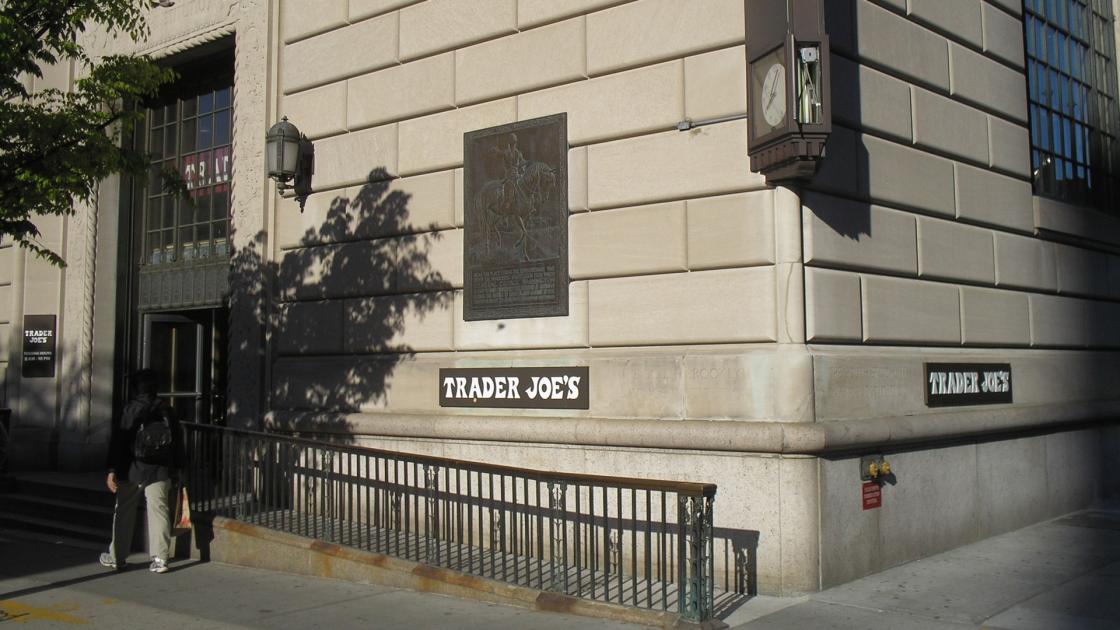
The South Brooklyn Savings Institution was erected on the former grounds of the Ponkiesberg fortification in the early 20th century. Today, it is occupied by a Trader Joe's, but retains the orginal tablet commemorating the battle.
Park on the street and walk to the corner of Court Street and Atlantic Avenue to find the bronze historical marker on the side of the building, directly above the “Trader Joe’s” sign. Yes, you’re at the right place—this 20th century bank building is now home to a grocery store.
Just two years after the South Brooklyn Savings Institution opened here in 1924, the bank erected this tablet on the 150th anniversary of the Battle of Brooklyn. The landscape here has changed significantly over the years, but in 1776 you’d be atop a very tall hill in the middle of Cobble Hill Fort, the innermost defenses of the American position in Brooklyn. From here atop this hill, General George Washington could see what the soldiers on the ground could not—the advancing barrage of thousands of British troops. One soldier later recalled that during the battle, “Most of our generals were on a high hill in our lines, viewing us with glasses. When we began our retreat, they could see the enemy we had to pass through, though we could not. Many of them thought we would surrender in a body, without firing.”
But of course, the men did not surrender. “Good God, what brave fellows I must this day lose!” Washington reportedly exclaimed, wringing his hands in shocked agony at the sight of the Maryland 400’s stand against the British at the Old Stone House. Those men who were not killed in battle and not lucky enough to make it across the creek, were taken prisoner. Your next stop tells their story.
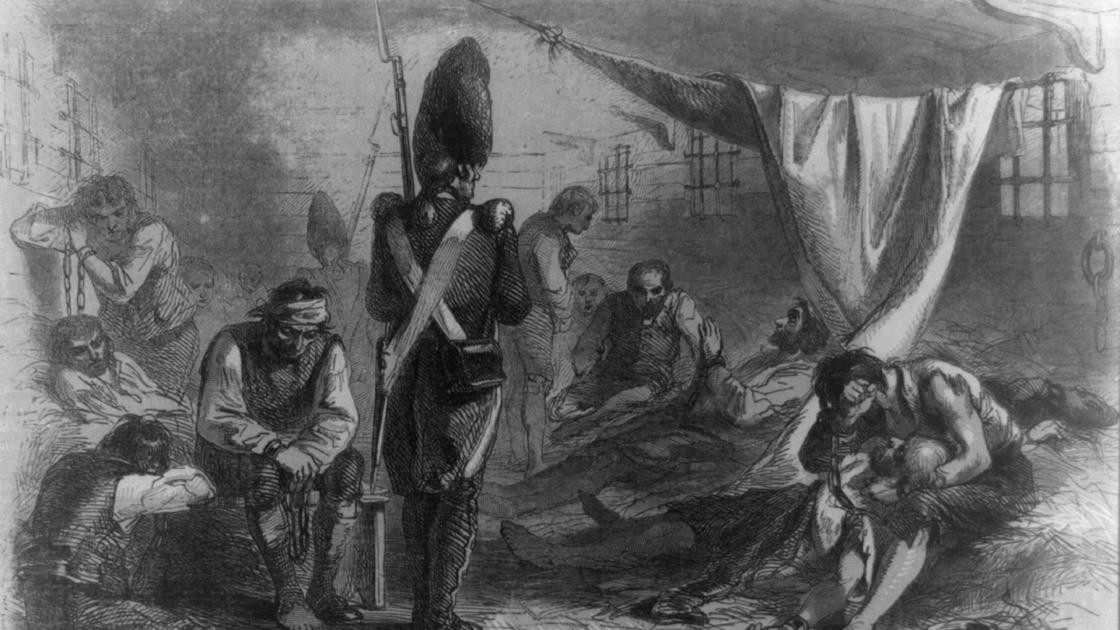
The conditions prisoners faced on British prison ships were dismal and resulted in many prisoners dying of disease whilst in captivity.
Park on the street and walk up to the Prison Ship Martyr’s Monument.
Here inside the aptly-named Fort Greene Park, you’re standing on the high ground where American General Nathanael Greene built a star-shaped fort as part of the inner defenses of Brooklyn Heights. And you can see why during the Battle of Brooklyn this was such a strategic location. Here, you have a good view of the terrain of the Heights, as well as Wallabout Bay.
Wallabout Bay became important for the British not because of what happened during the Battle of Brooklyn, but because of their needs after. The Battle of Brooklyn resulted in over 1,000 patriot prisoners of war, and the British initially confined many of them to buildings in the city, with separate quarters for captured officers. Hessian forces captured 20-year-old Corporal William McMillan on August 27, 1776, as he was unable to escape across Gowanus Creek. McMillan described that his captors “gave us nothing to eat for five days, and then [they gave us] biscuits from aboard ships, Blue, moldy, full [of] Bugs & Rotten." McMillan was sent with other POWs to Halifax, Nova Scotia, where he eventually made an escape.
But few were as lucky. As POW numbers escalated and space ran low, the British turned to another solution, prison ships. By 1780 five ships and their captives floated here, include the most infamous of these ships, The Jersey, which earned the nickname “the Hell.” The men on board experienced nothing short of horrific conditions including overcrowding, hunger, smallpox, and dysentery. Mortality rates among POWs were high, with as many as 12,000 men succumbing to disease or malnutrition. Bodies were hastily buried in shallow graves on nearby shores, and over time these bones washed up on shore and became exposed to the elements. In 1908 many of them were reinterred here, in the mausoleum under this monument, which for a time was the tallest structure in Brooklyn.
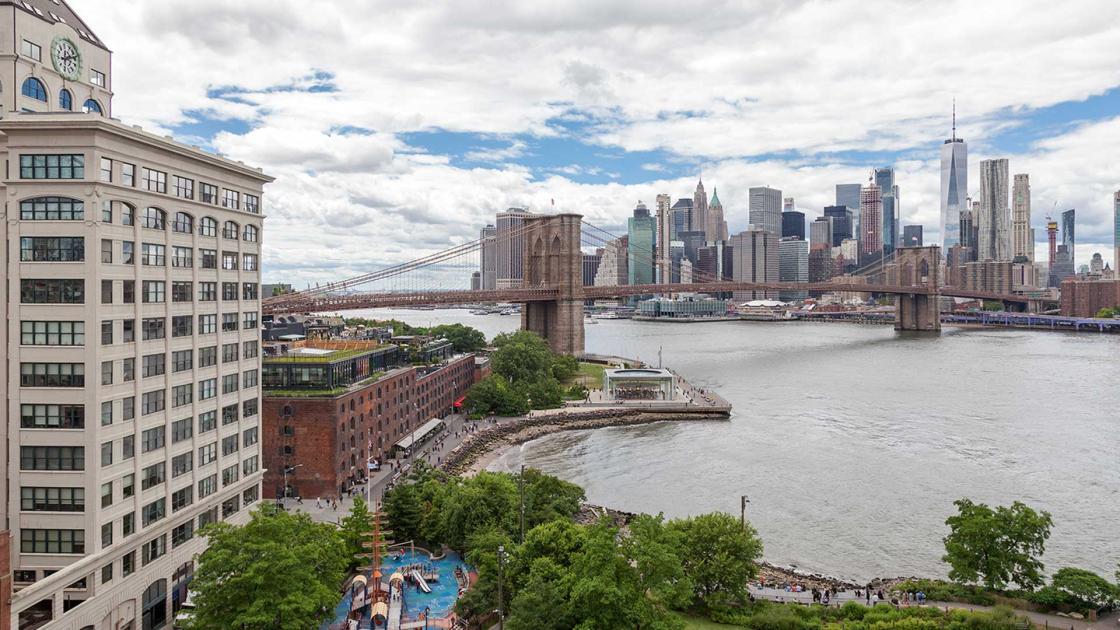
Near the location of the Brooklyn Bridge, American troops successfully evacuated New York.
Park on the street and walk into the park. Nearby is a boulder with a plaque marking the location of where the American evacuation of Long Island occurred on August 29-30, 1776.
You probably know the Brooklyn Bridge as an iconic New York landmark. This crossing is important to the Battle of Brooklyn, too. With his back to the river, General George Washington knew that he was in a vulnerable state. He had to get the Continental Army over the river and fast, before the British Navy could advance any further up the East River or British General William Howe could attack again. This is where patriots made their escape to Manhattan overnight on August 29-30, 1776. Except 250 years ago, there was no bridge here. Instead, Washington had to figure out how to ferry 9,000 battle-weary men across the river without being caught. Enter Colonel John Glover and his band of expert fishermen from Marblehead, Massachusetts, who helped orchestrate the retreat of Washington’s soldiers secretly overnight. Just four months later, Washington called on Glover and his men again to ferry the army over the Delaware River to attack the Hessians at Trenton.
22-year-old Lieutenant Benjamin Tallmadge remembered that “it was one of the most anxious, busy nights that I ever recollect,” remembering how he spent the night in the patriot trenches while waiting his turn to cross in the ferry. In the morning he awoke to a dense fog settling all around him: “I recollect this peculiar providential occurrence perfectly well; and so very dense was the atmosphere that I could scarcely discern a man at six yards’ distance.” Like the darkness of the night before, the timely thick fog allowed Washington’s troops to continue their crossing over the river in secret. “In the history of warfare,” Tallmadge wrote, “I do not recollect a more fortunate retreat.”
The British had won the Battle of Brooklyn. But the Continental Army—firmly clad in the armor of patriotism—lived to fight another day.

