-
The BlogBiographies
-
Videos

Reposted from battlefields.org
After his pyrrhic victory at the Battle of Guilford Courthouse, British General Charles Lord Cornwallis began withdrawing towards Wilmington, North Carolina. Initially pursuing Cornwallis’s army, General Nathaneal Greene turned south and moved back into South Carolina. Greene hoped to draw his opponent into another battle and defeat him on ground favorable to the Continental Army. Cornwallis, however, refused to take the bait, moving instead into Virginia.
For his part, Greene chose to focus on the British occupying forces that remained in the South. The British held a chain of outposts that ran from Augusta, Georgia, up through South Carolina. Camden, the site of a catastrophic American defeat in the summer of 1780, lay in the center of the British line. The British garrison at Camden was led by Lt. Col. Francis Rawdon, who had been left in effective command of British forces in the Carolinas and Georgia after the departure of Cornwallis.
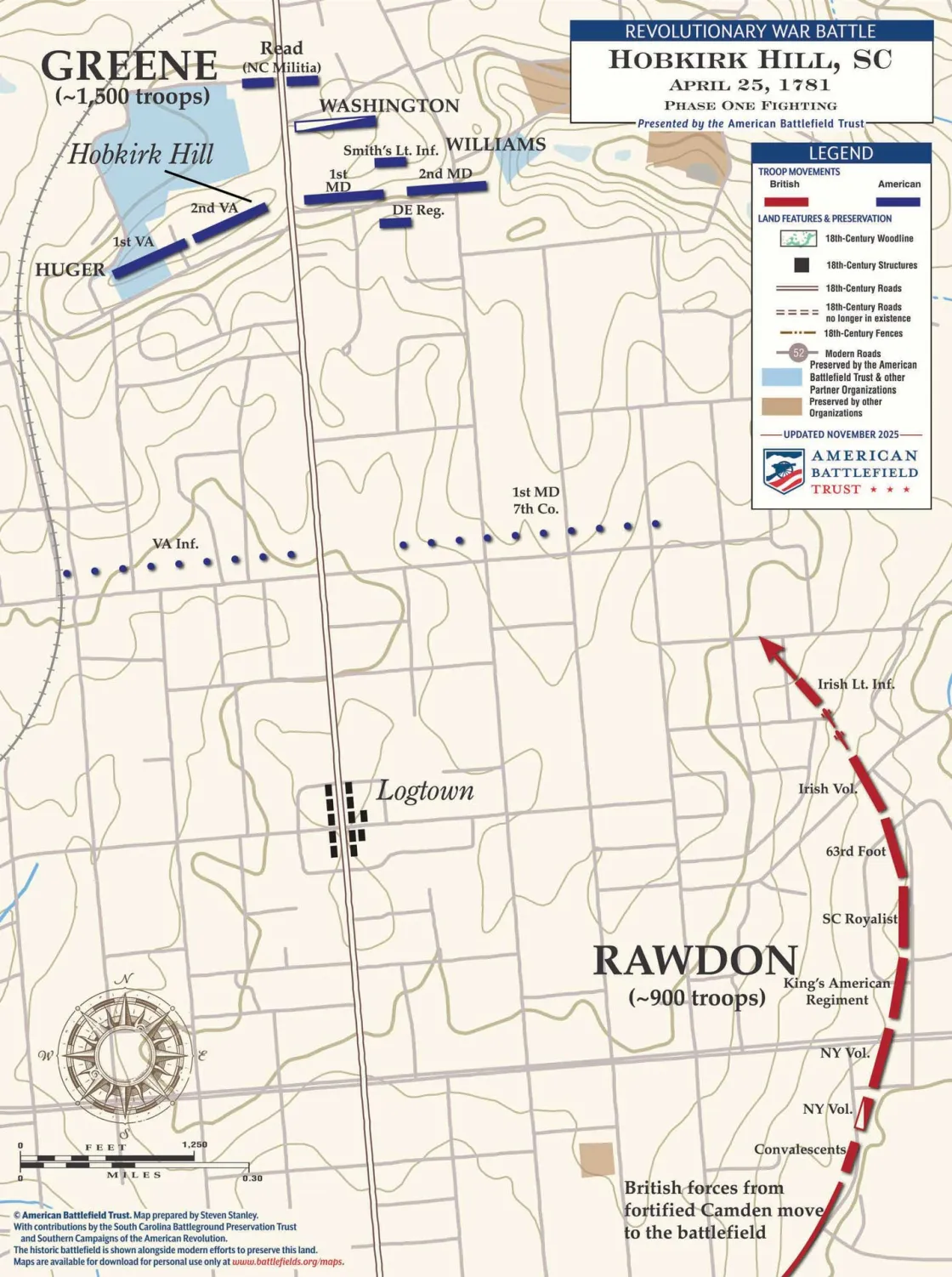
Although Greene attempted to approach Camden in secret, his arrival did not go undetected. The British forces positioned behind fortifications prepared for an American attack. Nonetheless, Rawdon was in a precarious position. Not only was his position threatened by Greene, but his supply line connecting Camden with Charleston was also under attack by Francis Marion’s partisan band. The British commander was forced to dispatch 500 men under Lt. Col. John Watson Tadwell-Watson to seek out and destroy the legendary “Swamp Fox.” Rawdon was left with only 900 men to defend Camden.
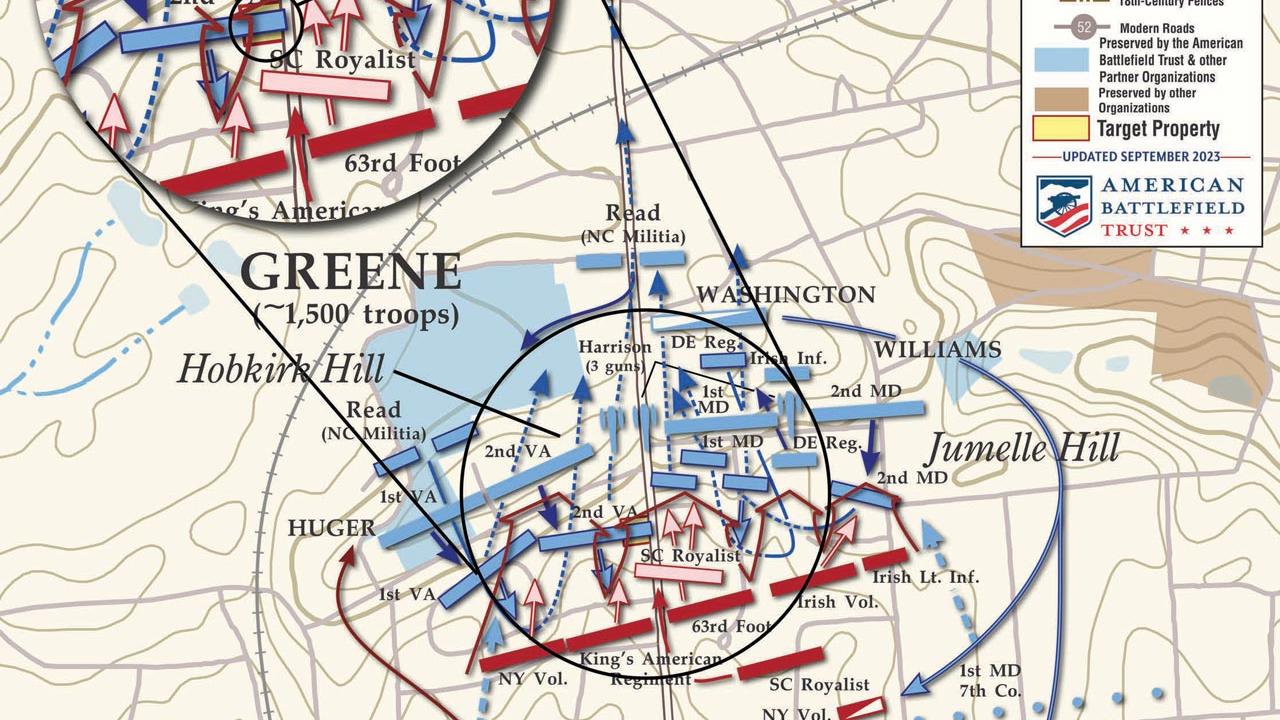
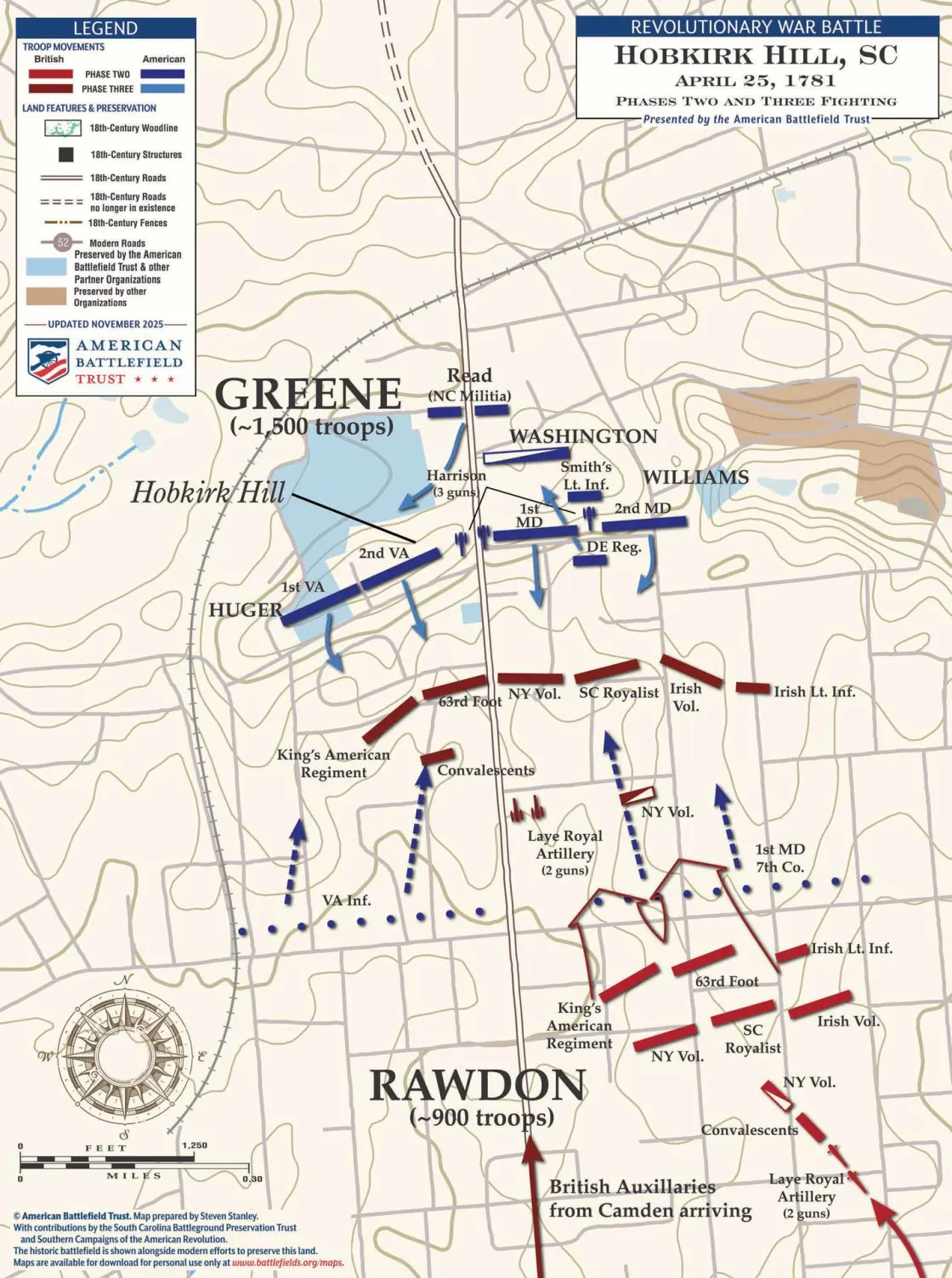
On April 20, Greene arrayed his forces on a ridge known as Hobkirk Hill, a mile and half north of town. Greene commanded 1,551 men, most of whom were regular Continental Army soldiers. He hoped to draw out and destroy the British army. The next day, Greene heard that Watson’s force was en route back to Camden. In response, the American general detached his artillery and a portion of his infantry to cover the road from Charleston.
On the morning of April 25, a deserter from Greene’s army arrived in Camden and informed Rawdon of the division of the American army. With the Patriots on Hobkirk Hill temporarily outnumbered and unsupported by artillery, the British commander decided to strike. He gathered as many of his men as were fit to bear arms, including his musicians, and advanced on Greene’s position.
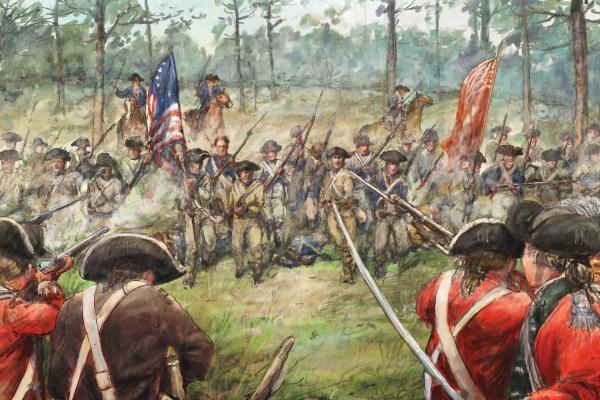
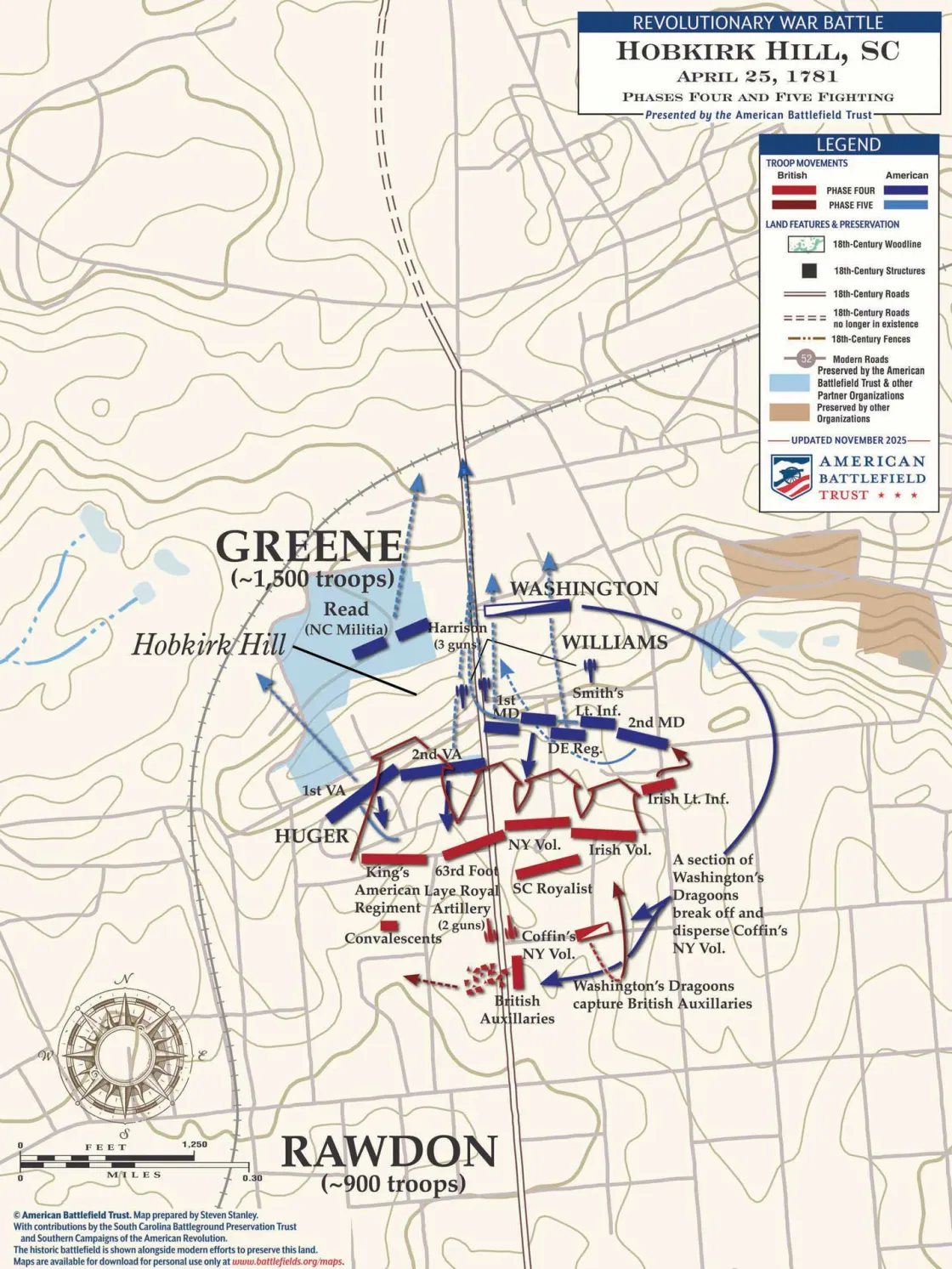
At around 11 a.m., musket fire from Greene’s pickets alerted the Patriots to their peril. As Rawdon advanced on Hobkirk Hill from the southeast, the American pickets fell back slowly, firing as they went and buying time for Greene to prepare. Suddenly, as the British moved forward, into a hail of grapshot hail of grapeshot. Unbeknownst to Rawdon, Greene had reunited his army early that morning after discovering that the rumor of Watson’s approach was false and attacked Rawdon’s flanks.
Greene’s attack initially went as planned. The British were confused by the unexpected presence of American artillery and suffered heavy losses. Some of Rawdon’s men fled before the American attack. Unfortunately for Greene, the Patriots’ attack began to unravel. Greene ordered a portion of his force to hold off the British attackers while the rest of the American army retreated. As Greene’s army retreated, some of the American gunners abandoned their pieces, leaving the artillery at risk of capture. Greene ordered the guns saved, and after a melee, they were extracted from the field.
As at the Battle of Guilford Court House, Hobkirk Hill was a pyrrhic victory for the British, who could ill afford heavy losses. Rawdon ultimately concluded that the American army was too strong, and on May 10, he abandoned Camden.