-
The BlogBiographies
-
Videos

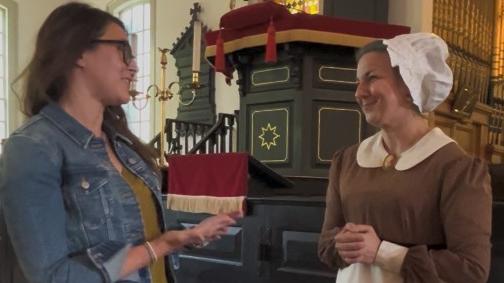
Hi, it’s Kate—and I’m on The Liberty Trail.
...and I’m not alone. I’m hanging out with one of my historic heroines, Abigail Adams.
I’ve just spent an hour in Richmond, Virginia’s Historic St. John’s Church, fangirling over getting to “meet” Abigail Adams. Brought to life through the impeccable storytelling of actor and historian Debbie Phillips, Abigail/Debbie introduced herself as the wife and “dearest friend” of John Adams (delegate to the Continental Congress, member of the Committee of Five, Vice President of the United States and 2nd POTUS, I could go on). But Debbie wove a beautiful monologue highlighting Abigail’s own accomplishments not just as a wife and mother but as a historian, intellectual, prolific writer, avid reader and, of course, a patriot. Debbie has just given a world-class, first-person interpretation of Abigail, informed by dedicated deep dives into Abigail and John’s surviving wartime correspondence. Can I just say—she slayed.
Historically, we have no record that Abigail ever visited Virginia. But knowing what we do of her as an enthusiastic patriot, it’s more than appropriate to envision her here at Historic St. John’s. This church, after all, is sacred ground for the Revolutionary cause. Patrick Henry pounded his chest and declared “give me liberty or give me death!” While Abigail’s own famous Revolutionary entreaty to John in the Continental Congress - “remember the ladies” - was a bit less dramatic, it echoes just as loudly in this old church as I imagine Patrick’s provocation must have. In her presentation, Abigail/Debbie reminds us that while some men like her hubby John were waging a war of words with pens, fighting for political independence, and arguing over language in the ultimate break up letter, other colonists turned soldiers were facing the world’s most professional army on landscapes up and down the east coast. They were fighting a very different war with cannon, muskets, and the tips of bayonets as communities became battlefields.
While John was steeped in the ideological and political American Revolution, Abigail was immersed in the harsh realities of the Revolutionary War. From Massachusetts, her letters to John in Philadelphia are full of the uncertainties, anxieties, and horrors she endured as the war unfolded around her. In June 1775, Abigail wrote to John describing the death of their friend Dr. Joseph Warren at the Battle of Bunker Hill, which she and her 7-year-old son (and future President) John Quincy witnessed from atop Penn’s Hill ten miles away:
My bursting Heart must find vent at my pen. I have just heard that our dear Friend Dr. Warren is no more but fell gloriously fighting for his Country…Charlstown [sic] is laid in ashes. The Battle began upon our intrenchments upon Bunkers Hill, a Saturday morning about 3 o’clock and has not ceased yet and ‘tis now 3 o’clock Sabbeth afternoon…How [many have] fallen we know not—the constant roar of the cannon is so distressing that we can not Eat, Drink or Sleep.
Debbie-as-Abigail’s recounting of this event was stirring, and I wanted to learn more. I wanted to imagine—and share with you—what historical Abigail Adams would have to say to modern day me about her life, legacy, and the American Revolution. So, I did what every historian wishes they could do with their historical idols—I interviewed her. Check out our conversation below.
Abigail’s revolutionary battle cry was to “remember the ladies.” So, I’m going to dedicate a lot of energies this semiquincentennial to researching, reading, and remembering the women of the Revolutionary era—I wouldn’t want to disappoint my historical heroine.
Do you?
Don’t disappoint (me or) Abigail! Remember the Ladies! Learn More:
Better than a romance novel! Read more of Abigail and John’s letters at the Massachusetts Historical Society: Adams Electronic Archive : Correspondence between John and Abigail Adams
Abigail wasn’t alone in her distress over Bunker Hill. Faith Trumbull Huntington had her own experience which impacted her and her family’s lives forever.
Looking for a great Abigail bio? Start here: Woody Holton, Abigial Adams, Free Press, 2009.
Check out all the American Battlefield Trust has to offer on Women in War: Women in War | American Battlefield Trust
Don’t have FOMO! You can find out about special partner events like this by visiting our Events page!
We invite you to visit the preserved locations along the Liberty Trail and to immerse
yourself in the extraordinary events that determined the fate of a nation.