-
The BlogBiographies
-
Videos

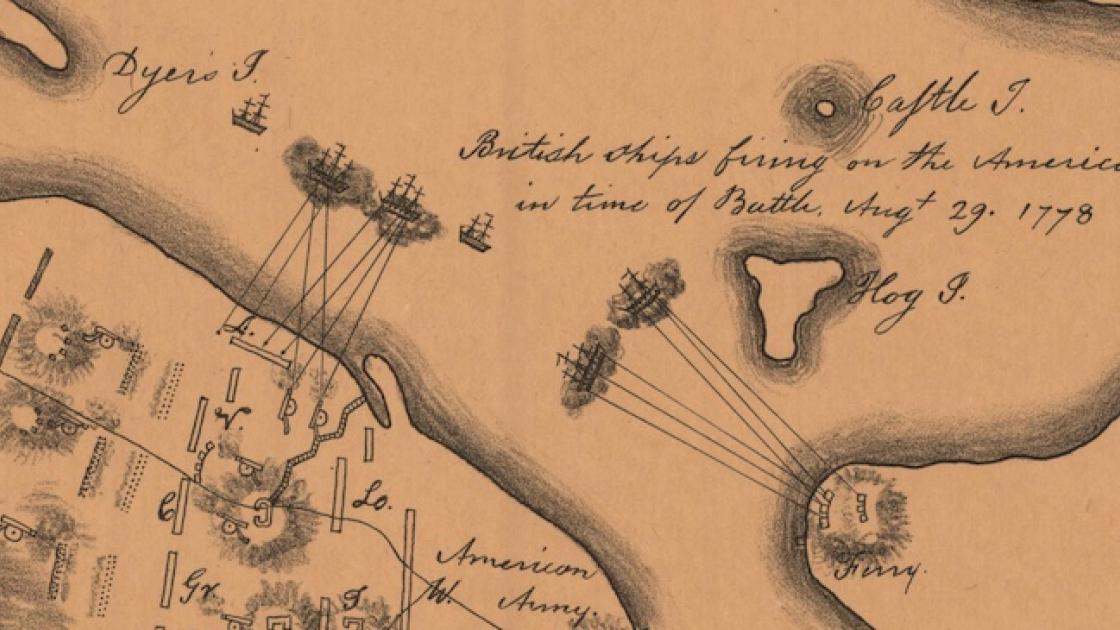
During the British occupation of Aquidneck Island (now Rhode Island) from December 1776-October 1779 during the Revolutionary War, the dazzling beaches and green meadows that draw visitors here today were crowded with British soldiers, their German forces (hired soldiers primarily from the Principality of Hesse-Kassel, often generalized as “Hessians”), and Loyalist supporters (Americans fighting for the British Crown). An armada of British ships dotted Narragansett Bay off Newport, restricting colonial trade. The British stripped the island of most of the trees for firewood, while seizing and occupying residents’ homes to quarter themselves. They fortified Portsmouth’s rolling hills to control the main ferry routes and to guard against invasion by rebel forces.
The Battle of Rhode Island, fought here on August 29, 1778, was part of the Patriots’ campaign to oust the British from Aquidneck Island. It was the first joint effort of the Americans and their new French allies. The plan was for the French to attack Newport by sea and for the Americans to invade by land. As the Americans’ intentions became clear to the British on Aquidneck, British General Sir Robert Pigot decided to deploy his forces defensively, withdrawing troops from the British fortifications at Butts Hill. On August 9, Patriot Major General John Sullivan learned that Pigot had abandoned Butts Hill and quickly ferried his men over from the mainland to seize and fortify that high ground to create a defensive line stretching across the island in case of British counterattack from Newport. Then he awaited French support from the water.
But it never came. A fierce storm on August 11 damaged the French ships and forced the fleet to sail to Boston for repairs. Without French support, the Americans lacked the strength to risk an attack on well-fortified Newport and decided instead to make a strategic retreat from Aquidneck Island. To give his men time to withdraw safely to the American lines back in Portsmouth, Sullivan positioned advanced guards at key positions along the East and West Main roads. The battle began as the Americans fought rear-guard actions to hinder the advance of British forces attacking to cut off and prevent Americans from evacuating. Ultimately, Sullivan successfully ushered his troops and equipment to safety, while the British re-occupied the entire island.
Begin your tour at the parking lot of the Portsmouth Historical Society, housed in a colonial schoolhouse built in 1725. The building was moved here from its original location across the street, where it witnessed, and luckily survived, an early skirmish of the Battle of Rhode Island and the British occupation of Aquidneck Island.
Walk through a gap in the stone wall to the front of the building, where you will see the Battle of Rhode Island monument erected by the Daughters of the American Revolution in 1910. Although it states that the first skirmish of the engagement took place on this site, primary sources place the earliest action nearby, at the other end of Union Street and West Main Road. There, at 7:00 a.m. on August 29, 1778, 250 Continental troops led by Patriot Colonel John Laurens faced off against 1.000 British soldiers under Hessian commander Major General Friedrich Wilhelm von Lossberg. The Hessians eventually broke the American line with their artillery, and Laurens’ infantry skillfully stayed shielded behind stone walls as they retreated on the West Road toward Turkey Hill, with Hessian Captain Friedrich Wilhelm von der Malsburg’s sharpshooters in pursuit.
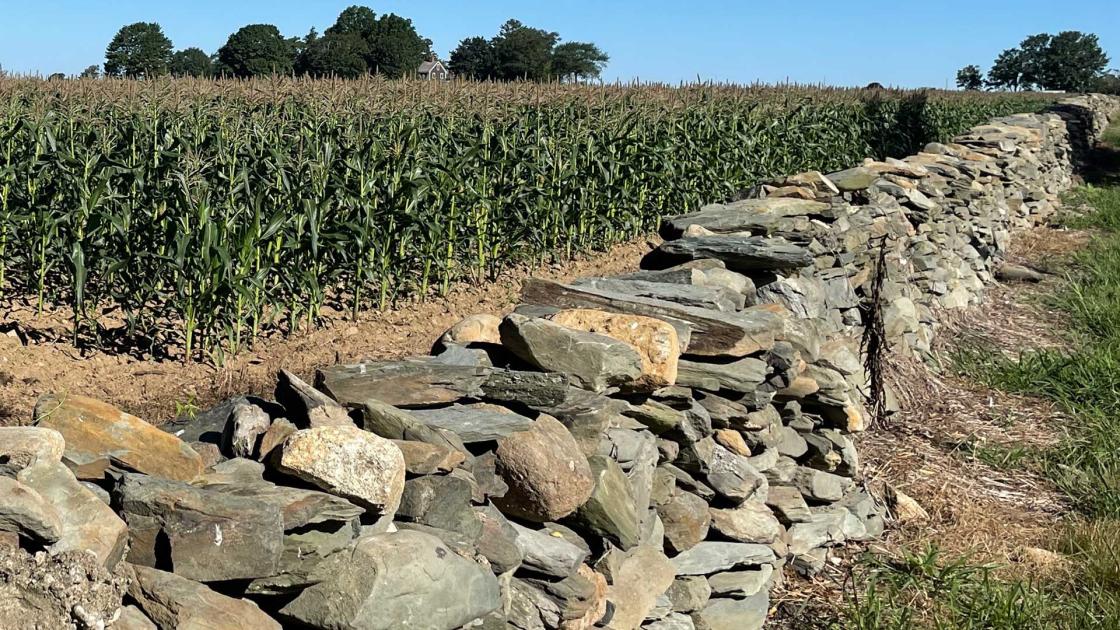
The skirmish on this ground began about an hour later. Under the orders of British commander General Sir Robert Pigot, Major General Francis Smith marched up the East Road toward Quaker Hill. Smith had more than 1800 troops and his men moved toward 950 Americans: Colonel Henry Livingston’s advanced guard, Colonel Henry Jackson’s New Hampshire troops, and Colonel Nathaniel Wade’s pickets. At 8:00 a.m., Wade’s pickets were concealed behind the stone walls that you see around you on Union Street, a short distance toward Middle Road. At Wade’s order, his men rose up from their hiding spots and fired two volleys at the approaching British troops. The British sustained heavy casualties in the ambush. While the Americans retreated toward Quaker Hill, Smith’s forces split, with part headed north on Middle Road while the rest proceeded up East Road.
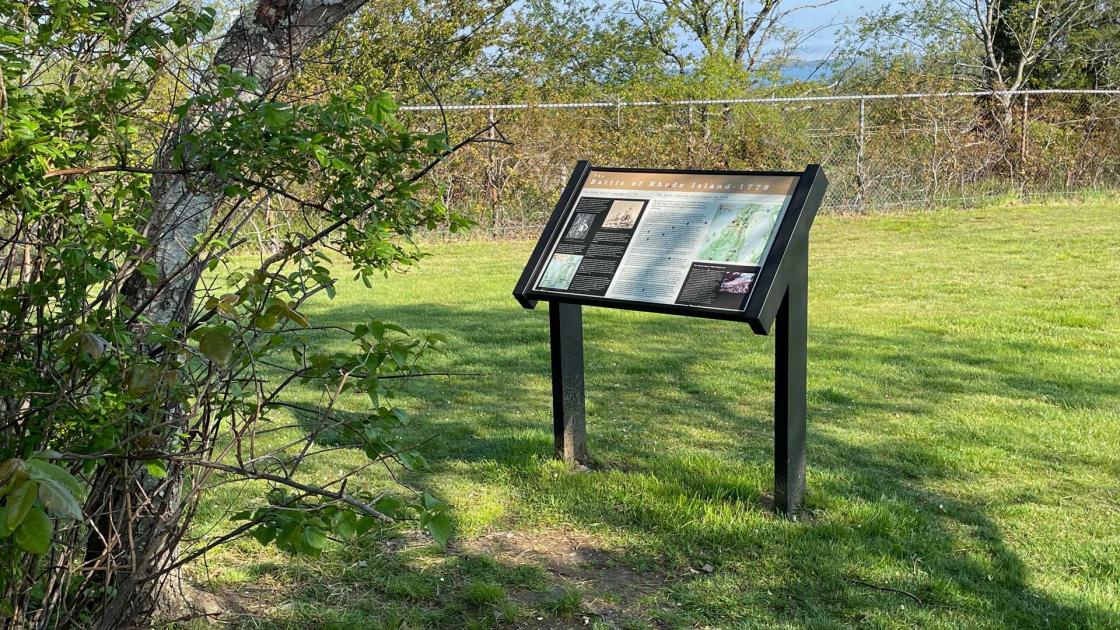
Revolutionary War troops marched on foot to Turkey Hill during the Battle of Rhode Island, but you can drive to Portsmouth’s Heritage Park and view the site from the scenic overlook. Park in the town lot on High Point Drive or on High Point Drive itself.
This large park, with its hills and wooded valleys, allows you to imagine what the landscape was like when Patriots clashed with British and Hessian troops on this ground. If you visit between October through April, when the leaves are off the trees, you can view the overlook area on the west side of the park by the chain link fencing and fully appreciate these 365 rustic acres that are listed on the National Register of Historic Places.
After his early morning skirmish with Hessian troops at West Main Road on August 29, 1778, Patriot Colonel John Laurens’ outnumbered force retreated toward Turkey Hill at 8:00 a.m. with Captain von der Malsburg's Hessians racing after them. Laurens’ men engaged the Hessians from a position just below Turkey Hill. Captain von der Malsburg's hand was wounded in the fighting. When Laurens’ men took a strong defensive position on Turkey Hill, the Patriot commander requested reinforcements, but Major General John Sullivan ordered Laurens to fall back to the main line and sent Colonel Samuel Webb's regiment of Connecticut Continentals and 40 soldiers from Colonel Henry Jackson's detachment to cover Laurens’ troops.
By 8:30 a.m. the Hessians had successfully taken a position on top of Turkey Hill. But they were out of ammunition. Von der Malsburg led his soldiers down into the valley between Turkey Hill and Durfee's Hill, where his troops took cover behind stone walls to wait for more supplies. American artillery north of here on Butts Hill kept the Hessians pinned down, prompting von der Malsburg to send his own artillery back to the top of Turkey Hill to pound the American right wing.
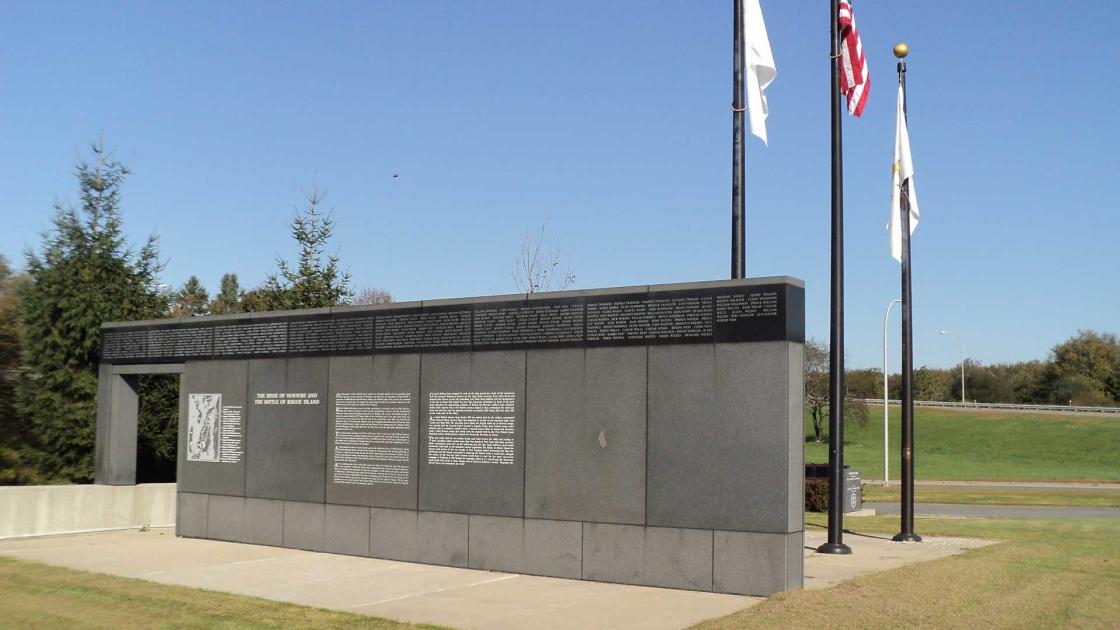
At Patriots Park a stone monument bears the names of those men who served with the 1st Rhode Island Regiment of the Continental Army and fought valiantly at Battle of Rhode Island on August 29, 1778.
Early in the war, the Continentals made efforts to keep free and enslaved African Americans out of their ranks, yet some still served. Necessity forced a change in regulations. When Rhode Island had trouble meeting its recruitment quotas with only eligible white men after sustaining heavy casualties during the Philadelphia Campaign, Brigadier General James Mitchell Varnum wrote to Commander-in-Chief George Washington suggesting that the ranks be filled with Black and Native Americans. On February 14, 1778, the Rhode Island Assembly voted to allow “every able-bodied Negro, mulatto, or Indian slave in this state to enlist into either of the Continental Battalions being raised.” The enslaved were offered freedom, and their owners were compensated for their monetary value. By the summer of 1778, the Regiment had around 200 men, the majority of which were African American, and likely had the largest percentage of Black soldiers in an integrated unit during the American Revolution.
At the Battle of Rhode Island, the 1st Rhode Island Regiment, under the command of Major Samuel Ward, Jr., defended a redoubt on West Main Road. This was a critical position, which the Hessians attempted to take multiple times. The Hessians were eventually forced to retreat to Turkey Hill, while the two sides exchanged cannon fire throughout the night. The Newport Chapter of the National Association for the Advancement of Colored People (NAACP) is responsible for calling attention to the contributions of the soldiers of the 1st Rhode Island Regiment during the Battle of Rhode Island. The organization spearheaded the effort to find the site of the redoubt, and through time, marked it with small memorials. In 2006, the NAACP dedicated this memorial to the Black Regiment. Now all can see the names of the unsung soldiers who helped secure liberty for our nation and remember their individual sacrifices.
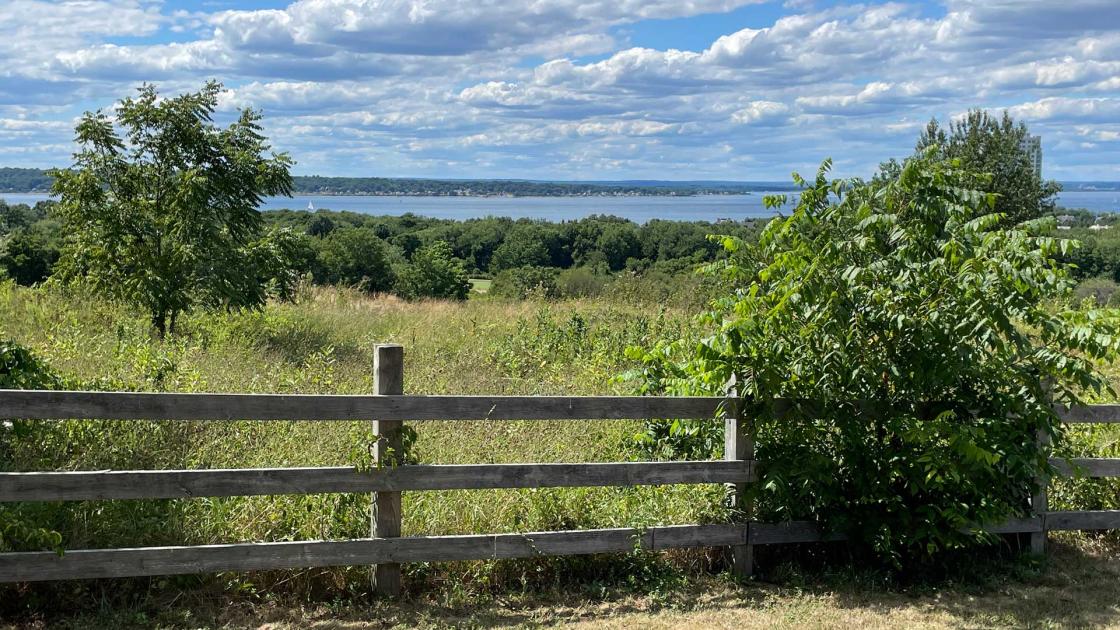
As you drive up Lehigh Hill heading north you will see an area where you can pull over and park. This site offers a view of the west coast off Portsmouth, where American cannon fired on British ships anchored in Narragansett Bay during the Battle of Rhode Island on August 29, 1778.
There was a significant naval component to the Battle of Rhode Island. Illustrated maps from the time show three British vessels—Sphynx, Spitfire, and Vigilant—off the coast under the command of British Captain Alexander Graeme. Graeme’s goal was to destroy the American battery at Bristol Ferry (on the Bristol side) and block the Americans from retreating to Bristol. But the waters proved too shallow for the British ships to navigate.
By about 10:00 a.m. on August 29, 1778, the Patriots were being flushed out of the area in the valley north of Turkey Hill. At about noon, Hessian commander Major General Friedrich Wilhelm von Lossberg tried again, as he had earlier in the day, to dislodge the American forces on the west side of the island. He coordinated with the British ships. In response to the naval bombardment, Patriot Major General Nathanael Greene positioned a cannon at the beach to damage the British fleet. The ships continued to pound Greene’s forces, but American artillery successfully drove them away.
At one point, Greene saw an opening to attack a vulnerable spot in the Hessian lines. He sent in Colonel Henry Sherburne's and Colonel Henry Jackson's Continentals. The American line included 1600 soldiers. A bayonet charge by Jackson's troops helped turn the tide. Greene then sent in General Solomon Lovell's brigade with Colonel John Trumbull in charge, to attack the Hessians. The British forces began to retreat to Turkey Hill. The fight on the west side of Aquidneck Island ended at about 3:30 p.m.
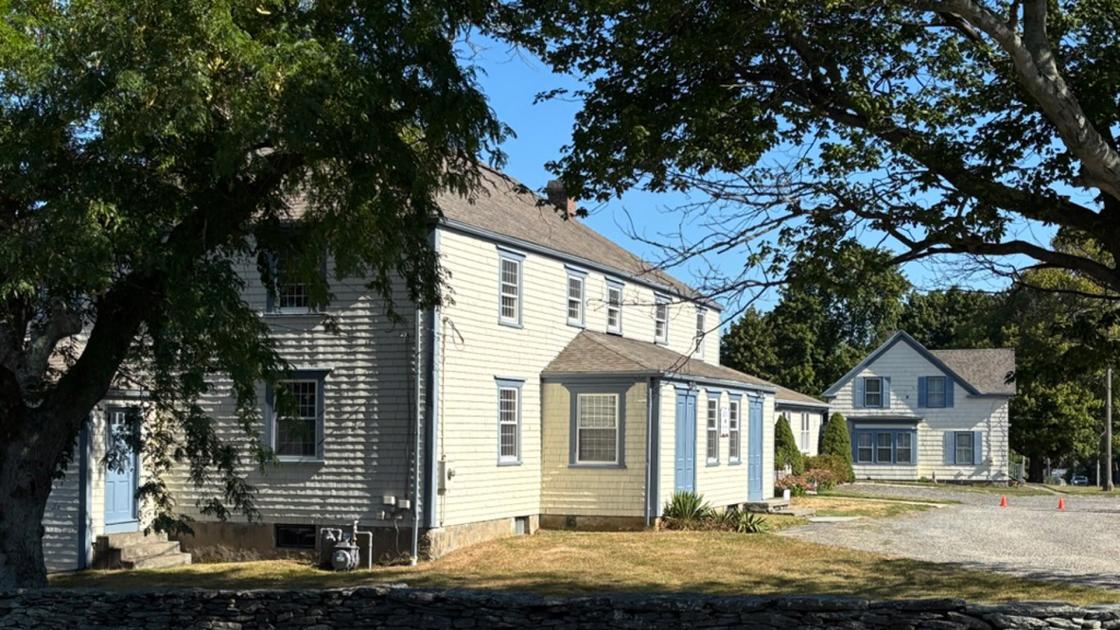
Park at the Friends Meeting House at 11 Middle Road. Constructed around 1700, the meeting house survived some of the heaviest fighting during the Battle of Rhode Island, which occurred where East Main, Hedley, and Middle Roads meet. When the British occupied Aquidneck in 1776, the building was used by English and Hessian troops for barracks and ammunition storage. It may also have served as a field hospital during the battle itself.
Before 9:00 a.m. on August 29, 1778, British Major General Francis Smith and the 43rd Regiment pushed up Middle Road while the 22nd Regiment proceeded up the East Main Road. American units (Colonel Edward Wiggleworth’s regiment, Colonel Henry Livingston’s advanced guard, and Colonel Nathaniel Wade’s pickets) were waiting at the junction of Middle Road, East Road, and Hedley Street, where the Quaker Meeting House stands. Patriot Major General John Sullivan sent in Colonel William Shepard’s regiment of Massachusetts and his Life Guards to support them. American troops not only held, but they also counterattacked in some of the heaviest fighting of the day. For a while it seemed like Americans had the advantage, until von Lossberg sent troops from the direction of Turkey Hill east to flank them. But American soldiers confused the blue coats of the Hessians for the blue uniforms of their own forces. Quick intervention by Major General John Sullivan’s aide, John Trumbull, saved the day. Trumbull, who later made famous paintings of the American Revolution, rode into the fray and ordered Wigglesworth to quickly retreat. In his Reminiscences Trumbull wrote of that dangerous errand:
"Nothing can be more trying to the nerves, than to advance deliberatively and alone into danger. . . I saw Captain Walker, of H. Jackson's regiment, who had received a musket ball through his body, mounted behind a person on horseback. He bid me a melancholy farewell and died before night. Next, grape shot began to sprinkle around me, and soon after musket balls fell in my path like hailstones."
While American writers documented an orderly retreat, British writers recorded that the Americans fled. Almost half the casualties of the battle came from the skirmishes on East Main Road.
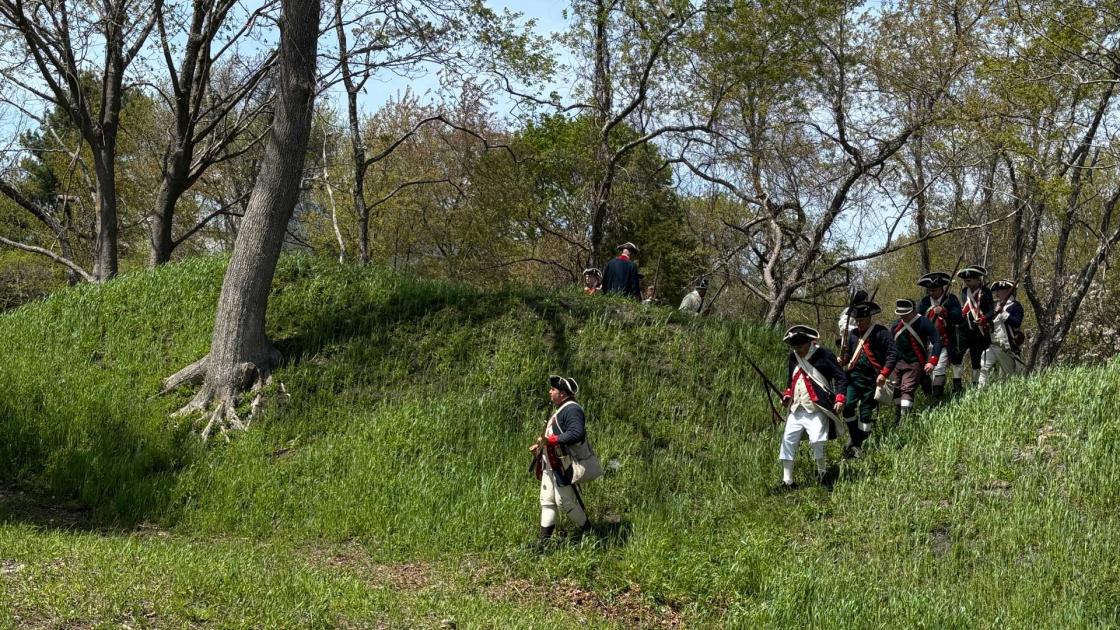
Park on Dyer Street and follow the East Trail at the end of the street. Head north to the fort monument, erected in 1923 by the Newport Historical Society to honor those who fought and died in the Battle of Rhode Island.
The fortifications at Butts Hill were originally built by the British in 1777, when they occupied Aquidneck, and were abandoned by British troops when they retreated to the south part of the island in early August of 1778 as the French fleet arrived to support the Patriots. When Patriot Major General John Sullivan’s ground troops landed on the island, they used the empty fort as their camp, and it served as the general’s command center. The British had left military works and a barracks toward the north of Butts Hill, where they could view the ferries to Bristol and Tiverton. The Americans began to work on defenses on the south side with a view of the East and West Main Roads. This enabled them to see the skirmishes unfolding on Turkey Hill and Quaker Hill.
As Sullivan began preparing for an orderly retreat from the island in late August 1778, he had his army increase defenses at Butts Hill and fortifications guarding the Bristol Ferry and the ferry to Tiverton. He wanted to get all his weaponry out so it would not fall into enemy hands. On August 29, 1778, Sullivan ordered the units fighting on Quaker Hill to retreat to the main line around the fort. The British attempted to attack the fortifications at Butts Hill but Sullivan’s roaring 18-pound cannons discouraged them from advancing.
As you walk around the site today, you can see to the north the oldest portion of the fortification, built by the British in 1777. The large grassy area in front of you is the parade grounds where soldiers assembled and drilled. To the left, are the British barracks. To the south are the fortifications started by the Americans during the Battle of Rhode Island. The shape of the fortifications now differs from 1778 and reflect modifications designed by French engineers and worked on by the Americans, including the Black Regiment, in 1780-81. The fort is the largest earthen work fort in the Northeast United States.