-
The BlogBiographies
-
Videos

January 17, 1781
A stunning example of skilled leadership by Patriot Brigadier General Daniel Morgan, the Battle of Cowpens was a critical American victory in the Revolutionary War. This engagement, in which British Lieutenant Colonel Banastre Tarleton’s elite force was humiliated by local militia and Continentals, further weakened the Crown’s attempts to control the southern colonies and inspired the Patriots to continue the fight for independence.
When you turn off the main road into the Cowpens National Battlefield, you enter the site of a pivotal engagement in the Revolutionary War. Today it is difficult to imagine how this gentle and sparsely wooded ground accommodated about 1,000 Patriots and 1,000 British soldiers, who clashed at close range and in the fog of gunfire. The intense fight on this field, between elite British troops under the notoriously cruel Lieutenant Colonel Banastre Tarleton and Continental and militia troops led by veteran officer Brigadier General Daniel Morgan, lasted less than an hour, but it was part of a chain of important Patriot victories in the backcountry that ultimately led to the British surrender at Yorktown.
The British had counted on Loyalist support when they turned their attention from the northern colonies and launched a Southern Campaign in 1778. However, after they captured Charleston in 1780 and established outposts throughout the Carolina countryside, that hope began to fade. Partisan leaders, either working alone or in loose collaboration with one another, provided stubborn resistance in a region that had been paralyzed by the British occupation. These men — like Thomas Sumter, Francis Marion, as well as Andrew Pickens, who led the militia here at Cowpens — fanned the spirit of revolt in remote areas and fought a relentless and savage war against their Loyalist neighbors. The intensity of the violence in the backcountry stunned Carolina outsiders such as Patriot Major General Nathanael Greene, who later said, “The whole country is in danger of being laid waste by the Whigs and Torrys, who pursue each other with as much relentless fury as beasts of prey.” That fury helped fuel the Patriot victory at Cowpens.
In December 1780, Commander of the Southern Army, Major General Nathanael Greene, decided to divide his Patriot forces into two parts to deploy them more effectively against the British in South Carolina. He led one division southeast from Charlotte, North Carolina, and sent Daniel Morgan’s troops southwest to threaten the fortified British base of Ninety Six. Morgan moved from Charlotte with a “Flying Army” of light troops on December 21 and headed to cross the Catawba and Broad rivers and set up camp on the north bank of the Pacolet. British commander Lord Cornwallis responded to the American maneuvers by splitting his own army into three elements; he would lead one himself, another would be under Lieutenant Colonel Francis Lord Rawdon at Camden, and the third column would be headed by brash Lieutenant Colonel Banastre Tarleton. Tarleton’s task was to stop Morgan from threatening the British post at Ninety Six and push him back across the Broad River, where Rawdon and Cornwallis would trap him. Once they dispensed with Morgan, the British would focus on stopping Greene.
After ensuring that Morgan was no threat to Ninety Six, Tarleton set out on an exhausting chase after the Patriot commander, who enlisted local militia to block the British advance. Tarleton, however, grew closer. By the afternoon of January 16, Morgan reached this pastureland, or “cowpens.” Now he had to make a choice: he could retreat away from the British and recross the treacherous Broad River, or he could stand here and fight. After weighing his difficult options, Morgan decided it was to his advantage to determine the place of battle. He prepared his men for the fight ahead. Meanwhile, the British followed the muddy tracks of Patriot horses and wagons to Cowpens, and after an overnight march of 12 miles, arrived on the battlefield as the sun came up.
As Daniel Morgan prepared to face Tarleton, he had the help of backcountry residents who supported the struggle for independence. These devoted Patriots didn’t, or couldn’t, always fight — especially if they were women. Kate Barry was one of those who risked her life to ensure that Morgan had the men he needed to successfully confront the British at Cowpens.
Mary Catherine “Kate” Moore Barry was born in Ireland. Her father, Charles Moore, received a land grant in South Carolina in 1763 and established Walnut Grove Plantation in Spartanburg County a few years later. When Kate married Andrew Barry, the couple settled there. During the Revolutionary War, Andrew served as a militia captain and Kate sometimes helped him as a messenger and scout. After Daniel Morgan put out a call for local militia to join his army, Kate, an accomplished horsewoman with intimate knowledge of backcountry roads, rode through the area, carrying word of his urgent request. Captured along the way by the British, Kate refused to submit to interrogation and was reportedly beaten for her silence. Still, she was able to round up a good number of troops for Morgan.
With time, Kate’s ride became a bit romanticized, but she is rightfully acknowledged for her bravery. Her actions certainly helped the Patriots on January 17, 1781, and though it may be untrue or exaggerated, the story of her mistreatment by the British served the rebellion by spreading anti-British propaganda throughout the backcountry. Kate died in 1823 and is buried in the cemetery at Walnut Grove. You can visit the plantation in Roebuck, South Carolina, and learn more about the life of this daring woman.
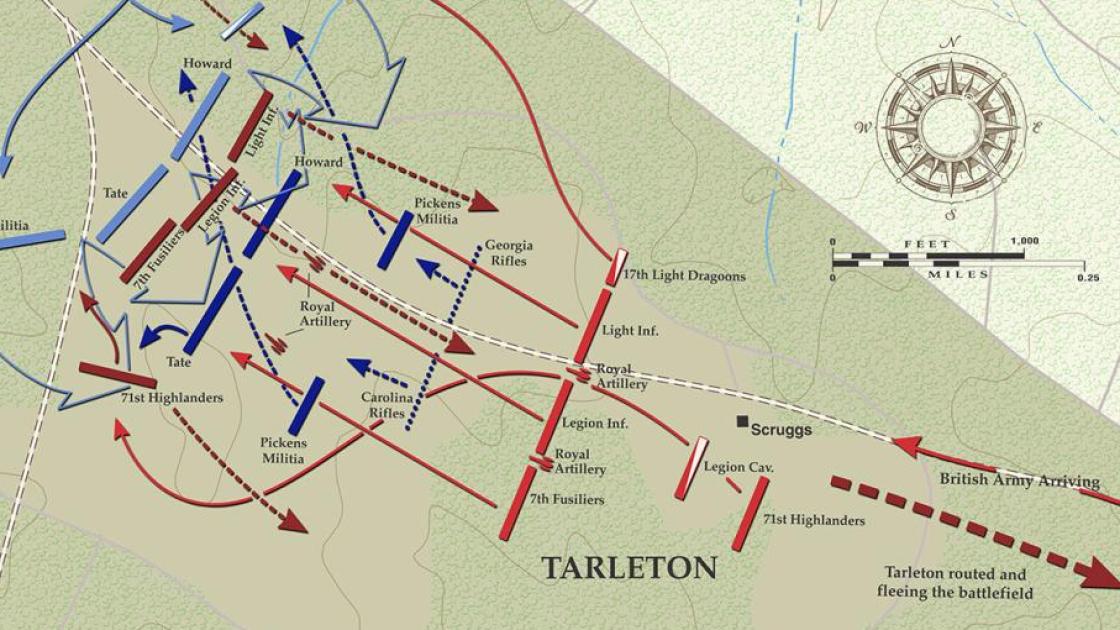
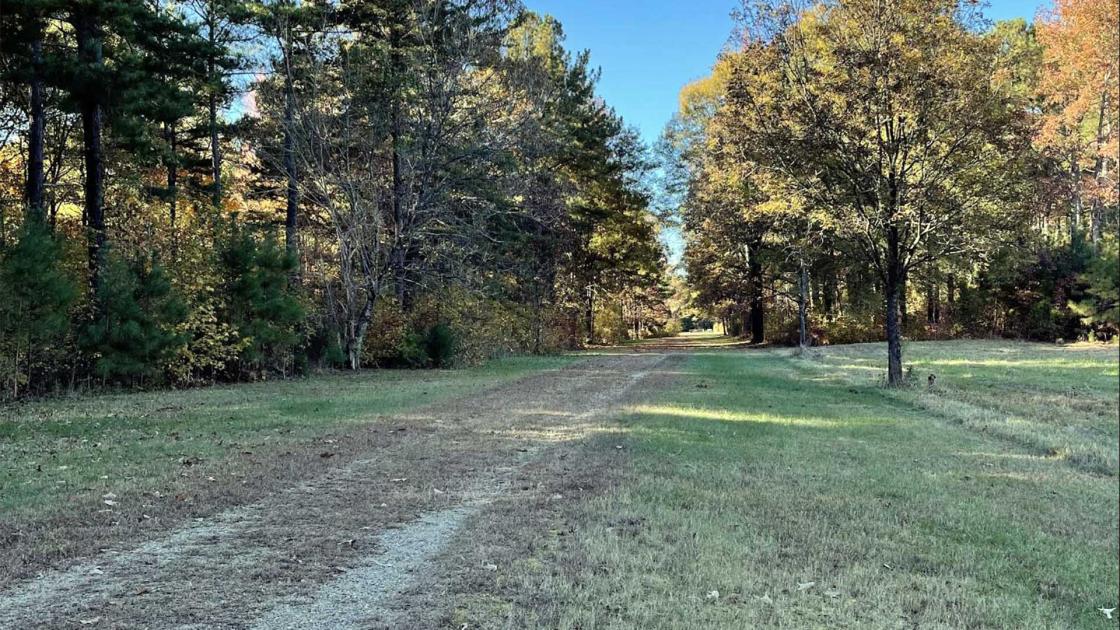
The Cowpens was a familiar local landmark and easy to reach on the Green River Road. Throughout the night of January 16, nearby Patriot militiamen, rugged soldiers who brought their own weapons, arrived to support Morgan. Most were loyal followers of partisan leader Colonel Andrew Pickens. By the morning of January 17, Morgan implemented his battle plan. A front line of riflemen, a second line of Pickens’ militia, and a third line of veteran Continental troops led by Lieutenant Colonel John Eager Howard were positioned on sloping ridges throughout the pastureland. Cavalry commanded by Lieutenant Colonel William Washington waited in the low woods where you stand now, concealed from the enemy. Morgan’s strategy, later known as a defense in depth, was to slow Tarleton’s advance and inflict as many casualties as possible, ideally before launching a counterattack.
The morning was bitterly cold and gray. An early fog impeded visibility as Tarleton approached from the south. The rolling terrain prevented the British from detecting the Americans until they got close. The Patriots, too, could not make out their attackers until they had almost crested the low hill, but being on higher ground, the sharpshooters had the advantage. Aside from a few trees, they had a clear view.
The British forces who confronted these Patriots on the field were a well-trained combined arms force of infantry, cavalry, and artillery. The infantry was comprised of the 7th Royal Fusilier Regiment, the veteran 71st Highlander Regiment, and the British Legion infantry. Tarleton’s mounted troops included the 17th Light Dragoons and mounted men of the British Legion. His artillery consisted of two three-pounder cannon manned with about 25 royal artillerymen. Tarleton also had a small component of Loyalists, who served as guides. The terrain at Cowpens proved to be more of an obstacle for the British. Tarleton’s avenue of approach to the battlefield was not wide enough to accommodate all his infantry into one front, and his troops—tired and hungry from their overnight march—were further hampered by impenetrable boggy-like vegetation called canebrake.
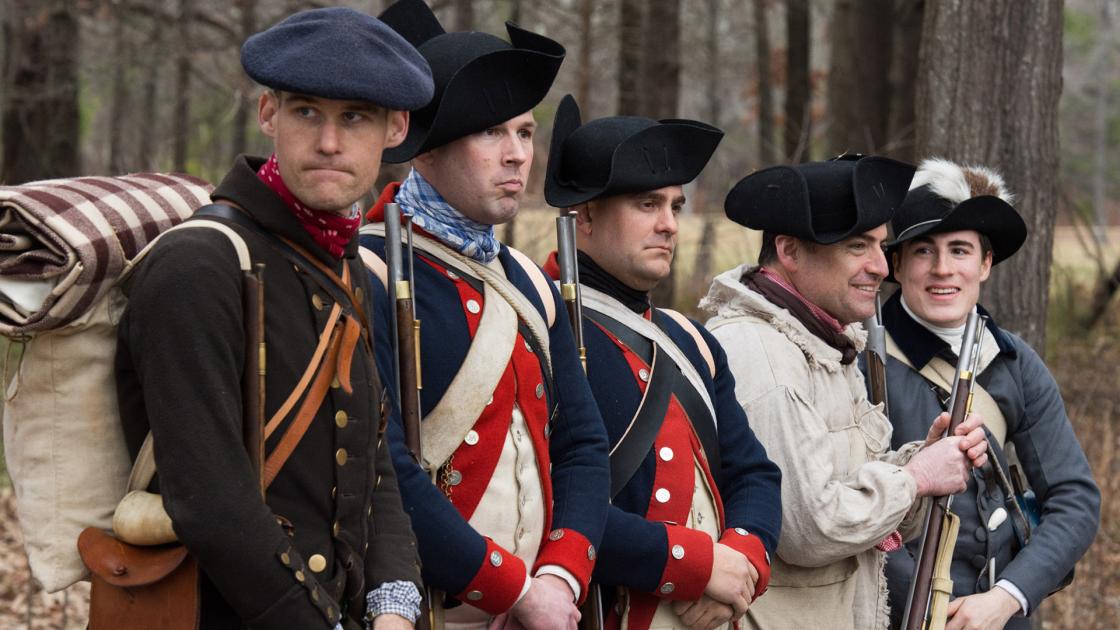
As Tarleton charged the third line of Continentals — the best trained and most battle savvy among the Patriot forces— Lieutenant Colonel John Eager Howard ordered his troops on the right flank to turn right and counter the British attack. Amid the gun blasts, smoke, and wailing bagpipes, however, the men misunderstood and began an orderly retreat. Morgan quickly rode up and commanded the men to turn around and fire at the enemy in unison. The sudden and deafening gunfire stunned the British, who, thinking victory was close at hand, broke ranks and were charging wildly at the Patriots. Many of Tarleton’s men fell immediately and others were soon struck down by Patriot bayonets. At that moment the first two Patriot lines, which fell back earlier in the engagement, reformed and reentered the battle. Tarleton’s men knew they were beaten. Some threw down their arms and fled. Others fought on halfheartedly, until Tarleton himself realized the fight was futile. He was chased off the field and fled down the Green River Road.
It was a huge victory for the Patriots. Whether by luck or design, Morgan successfully pulled off a rarely executed military maneuver called the double envelopment on the battlefield at Cowpens. By having his first two lines retreat and reform on the enemy’s flanks, his men were able to strike the British front and flanks, leaving them with no escape. Tarleton’s choice of a frontal attack left his flanks vulnerable and led to his humiliating defeat on this ground.
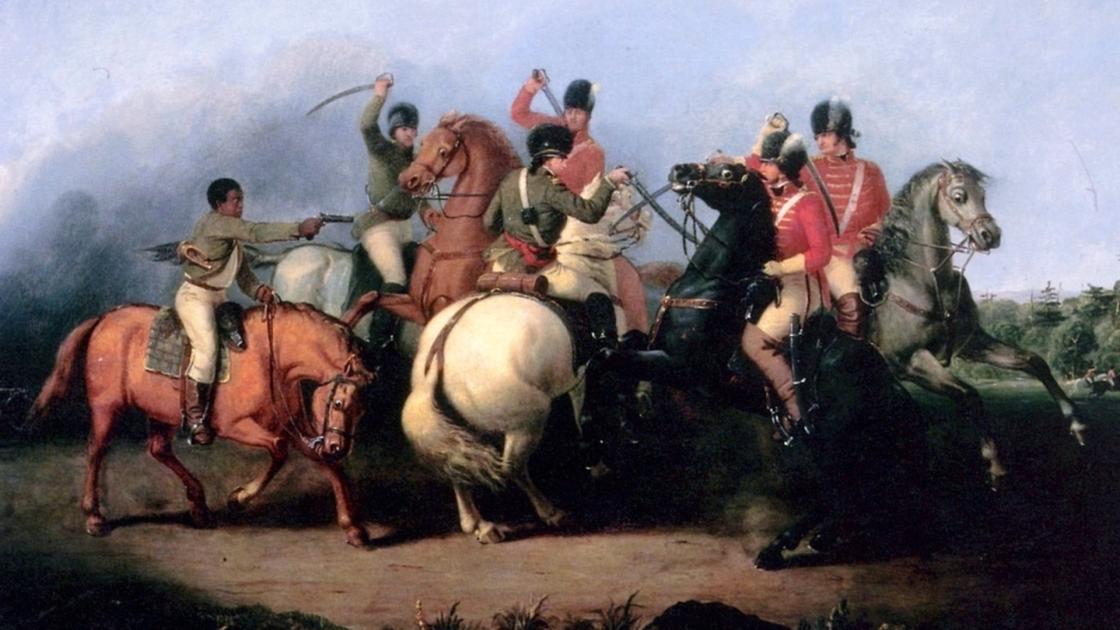
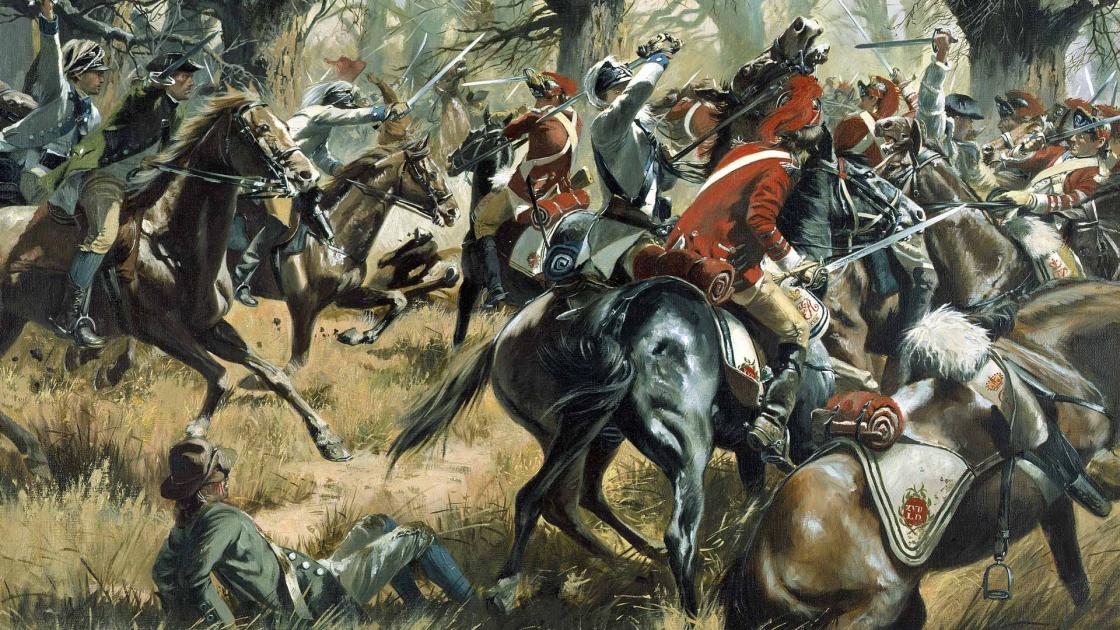
William Ranney’s dynamic 1845 painting “The Battle of Cowpens” hangs in the South Carolina State House in Columbia. It shows a Black bugler firing a pistol at a British officer to save the life of Patriot cavalry commander William Washington. The image references an actual incident that occurred at Cowpens as Tarleton tried to rally his Legion for one last counterattack and rescue the British artillery before leaving the field of battle. As some 40 or 50 British dragoons tried to save the guns, Washington, leading his cavalry, attempted to drive them away and was attacked by a British officer. In many accounts, this is glorified as an actual hand-to-hand duel between Washington and Tarleton, but there is no evidence that Tarleton was involved. Washington, however, did participate in some sort of personal engagement in which his horse was shot down. But, who is the heroic bugler? Two nineteenth century accounts refer to him as a “boy” and “waiter.” Neither of the descriptions note the trooper as being Black, though later sources say he was a Black man named William Collin or Collins or Ball. The names and identities of many Revolutionary-era Black soldiers — particularly those who did not apply for government pensions — were generally not recorded and lost to history.
We do know that there were other men of color on the battlefield on January 17, 1781, but we don’t know a lot about them. Using pension applications to document their service, the National Park Service names them as James Anderson (or Asher Crockett), Julius Cesar, Lemerick Farr, Andrew Ferguson, Fortune Freeman, Gideon Griffen, Morgan Griffen, Edward Harris, Allen Jeffers, Berry Jeffers, Osborne Jeffers, Andrew Peeleg, Dick Pickens, and Record Primes (or Primus Record).
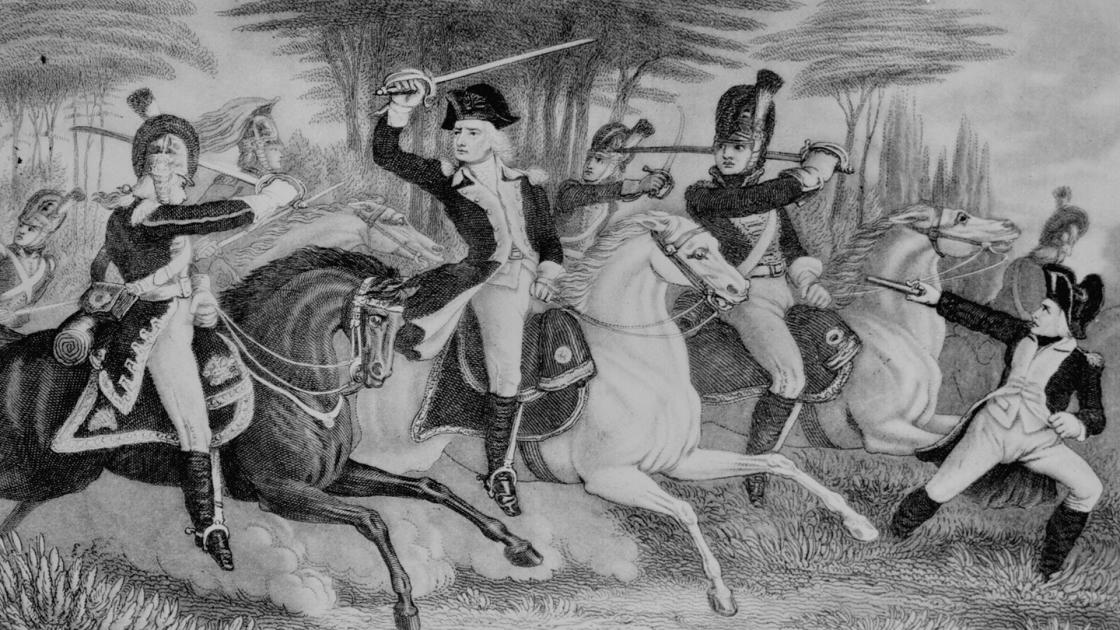
About 150 yards behind the skirmishers, Pickens commanded the main militia line of about 300 men, all standing shoulder to shoulder in a linear formation. These troops were on the reverse slope of a slightly higher ridge that hid them from the British. Per Morgan’s plan, each of the four battalions was to fire two or three shots then retreat toward the Continentals. When the British closed within 40 yards of the militia, Pickens's South Carolinians discharged their weapons at the British at close range. Some got off their two shots and retreated, but Tarleton’s elite dragoons were descending fast. With sabers drawn, they chased the militia, sending the terrified men fleeing for cover.
The Patriots might have lost their advantage in that moment had William Washington not arrived. His cavalry, which had been hiding in the low woods, appeared as if out of nowhere. Their sudden appearance so rattled the dragoons that Tarleton’s fine horsemen scattered, taking on many casualties in the effort. All the while the infantry on both sides continued to blast away, and through the smoke and confusion, Tarleton’s 71st Highlanders, with bagpipes blaring, entered the fray to confront the third line — Howard’s Continentals.
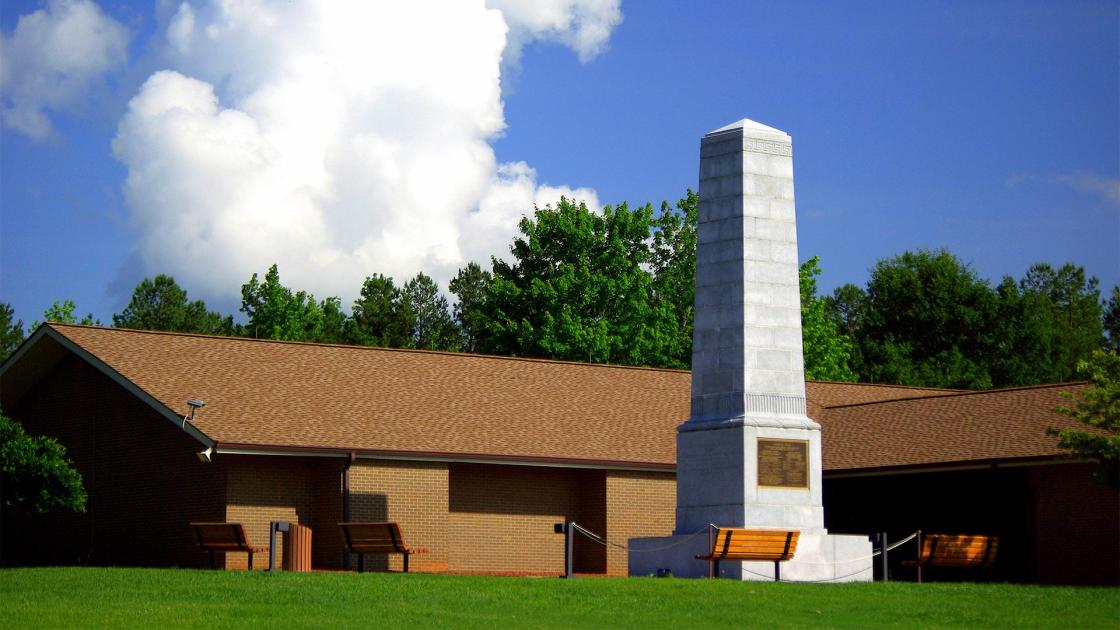
As you proceed along the battlefield loop, notice the monument to the Washington Light Infantry. The Infantry, a South Carolina militia group based in Charleston, was founded in 1807 and participated in every major war involving the United States until 1919, when the group became part of the South Carolina National Guard. Originally named in honor of George Washington, the militia eventually became more associated with his cousin, William Washington, who fought here at Cowpens. As controversy over slavery plagued the nation in the 1850s, the commanders of the unit sought a common project to unify their group and, on the 75th anniversary of the Battle of Cowpens, they erected this tribute.
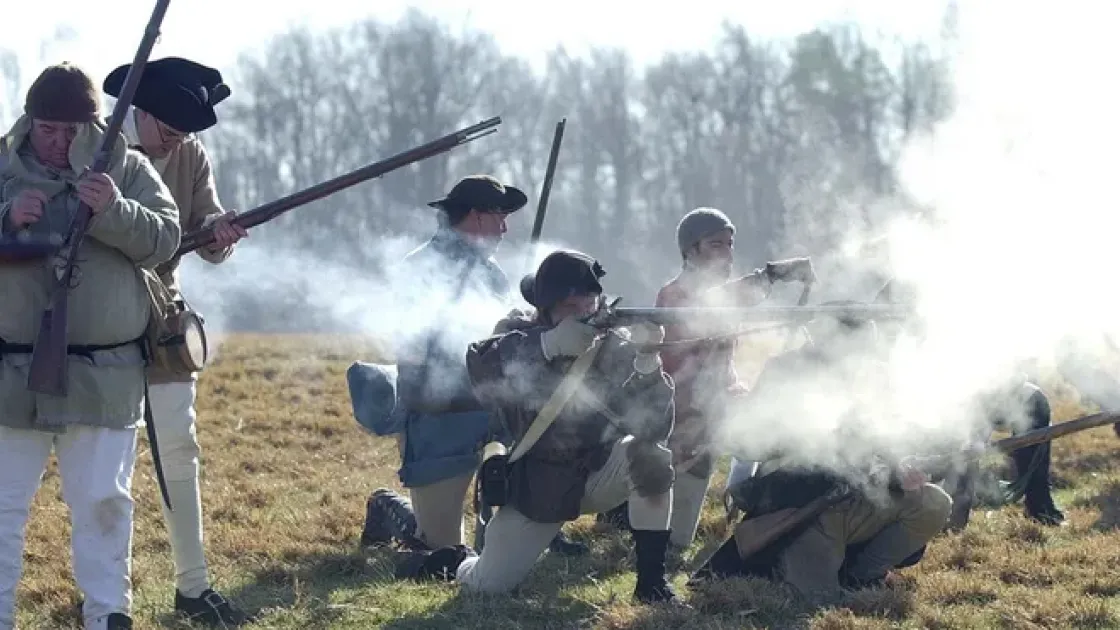
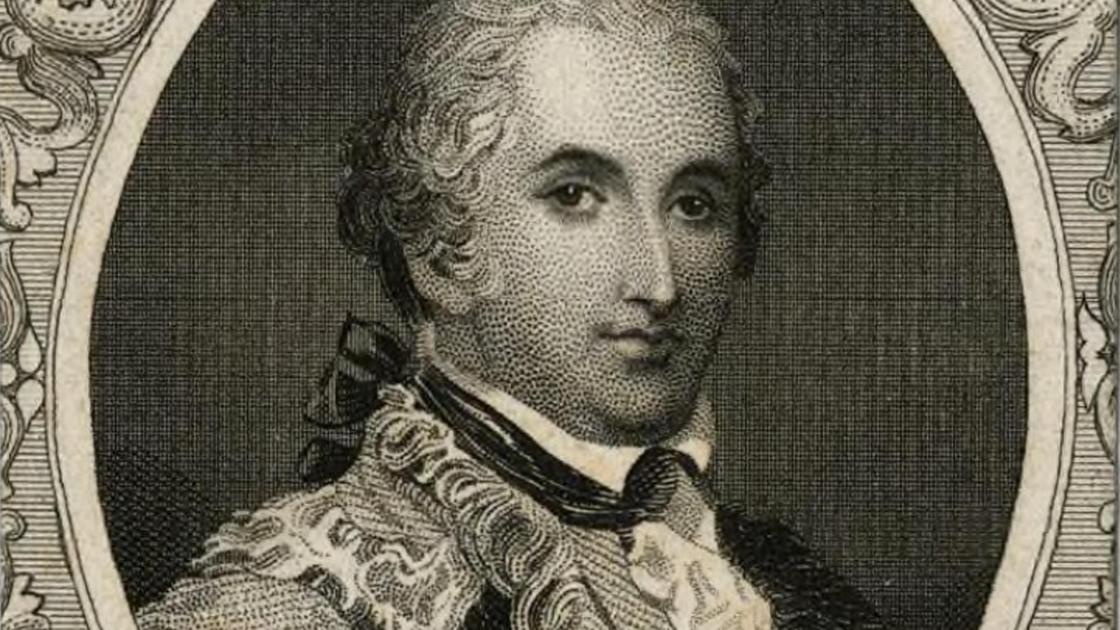
Tarleton’s early success in the war earned him several promotions and praise from British high command. He used speed, daring, and surprise to defeat his opponents and employed an effective combination of light infantry and cavalry in combat. Tarleton led by example and set a strong pace for his men to follow. He was so effective that on August 1, 1778, Lieutenant General Henry Clinton appointed him Lieutenant Colonel of the newly organized British Legion. He was only 23 years old at the time. When the British invaded the Carolinas in the spring of 1780, Tarleton’s efforts helped lead the British to victory. After the horrifying massacre of Patriots in the Battle of Waxhaws, however, Tarleton also became known for his cruelty. While Tarleton may not have actually ordered the massacre of American prisoners of war when they attempted to surrender, “Tarleton’s quarter” came to mean that no mercy would be given to captured rebels. American commanders used that perception to rally their soldiers to fight “Bloody Ban.”
The night before the battle, Morgan spent the evening moving from campfire to campfire, talking with his soldiers before combat and building their resolve to confront the intimidating “Benny” Tarleton. By this point in the war, the Patriot commanders knew Tarleton’s style, and Morgan was ready for his assault. Tarleton did not disappoint. The Patriot skirmishers, or sharpshooters — the first line — fired, picking off “epaulettes,” or officers in uniform. As the British vanguard retreated, the rest of Tarleton's force arrived. Tarleton deployed a battle line and quickly resumed the advance. The sharpshooters opened fire again and fell back 150 yards to join Pickens’s militia in the second line. This planned retreat was a critical part of Morgan’s strategy. Tarleton then attacked the Patriot second line head on, with his artillery in the middle and dragoons on each side.
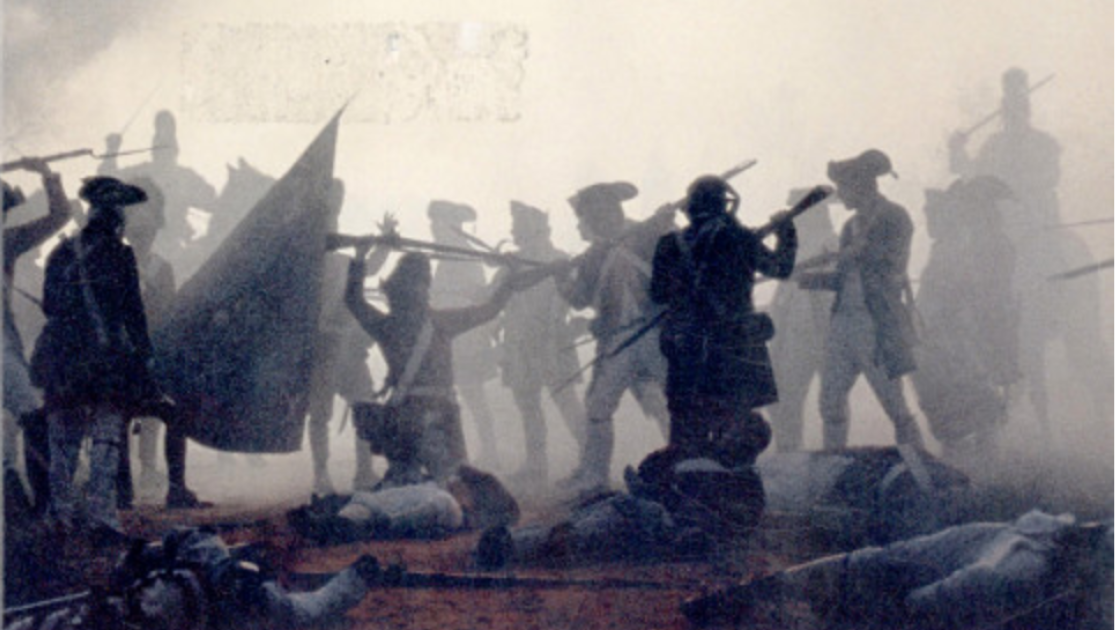
In only an hour of fighting, the British artillery and virtually all their infantry were killed or captured at Cowpens. Total British casualties were more than 100 dead, 200 wounded and about 600 captured. American losses were approximately 24 killed and 104 wounded. Writing from Cane Creek near Gilbert Town on January 19, Morgan informed Nathanael Greene, about the victory at Cowpens:
Dear Sir: The troops I have the honor to command have gained a complete victory over a detachment from the British Army commanded by Lieut.-Col. Tarleton. It happened on the 17th inst., about sunrise, at a place called the Cowpens… Our loss was very inconsiderable, not having more than twelve killed and about sixty wounded. The enemy had ten commissioned officers and upwards of one hundred rank and file killed, two hundred rank and file wounded, and twenty-seven officers and more than five hundred privates which fell into our hands, with two pieces of artillery, two standards, eight hundred stand of arms, one traveling-forge, thirty-five wagons, ten negroes, and upwards of one hundred dragoon horses…
Morgan also boasted to his friend William Snickers, “I have given [Tarleton] a devil of a whipping.”
Tarleton had a sorrier task. He had to find Cornwallis and relay the news of his staggering defeat. Upon learning that Cornwallis was camped north of him on Turkey Creek in present-day York County, Tarleton raced to the swollen Broad River at Hamilton’s Ford, threatening at swordpoint those soldiers who feared to cross its flooded banks. When he finally delivered the report of the battle to his superior, it did not sit well. According to an American eyewitness who had been taken prisoner by the British, an angry Cornwallis leaned so hard on the hilt of his sword that it snapped in half.
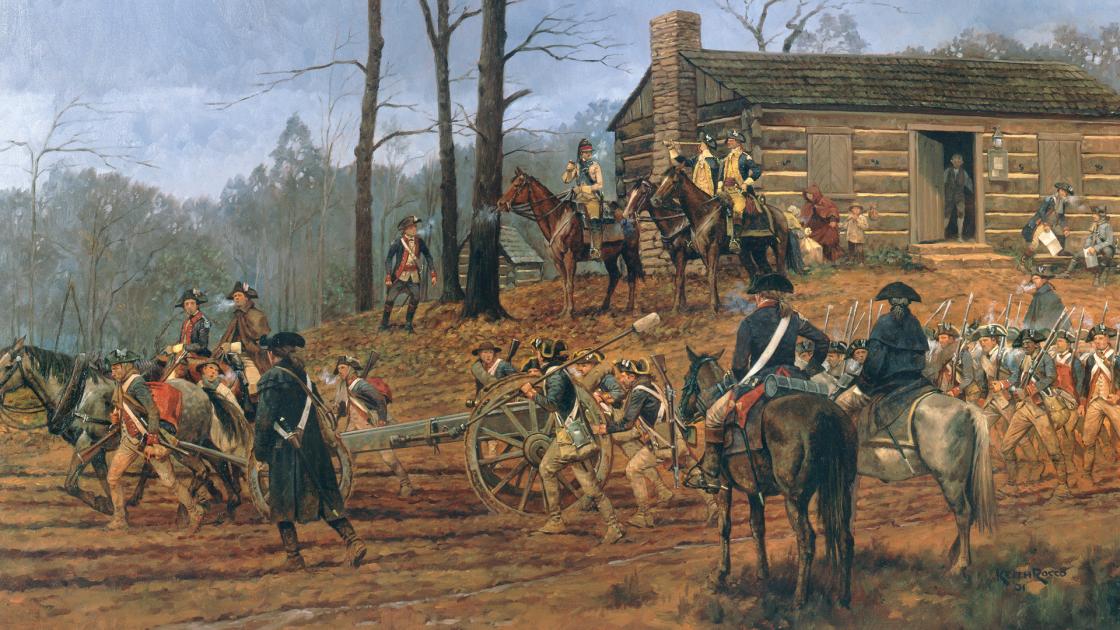
After the battle, Morgan knew Cornwallis would come after him. He moved as quickly as possible northwest on the Island Ford Road toward the Broad River. The river crossing was arduous because, in addition to transporting his men and supplies, Morgan also had almost 600 British prisoners in tow. On January 18, William Washington rejoined Morgan at Gilbert Town. He had unsuccessfully tried to catch up with Tarleton after the battle but managed at least to round up almost 100 British army stragglers. At Gilbert Town, Morgan gave Andrew Pickens charge of the prisoners with orders to get them beyond the Catawba River and out of Cornwallis’s reach.
With his forces thinned after the debacle at Cowpens, Cornwallis, as predicted, pursued Morgan in the hopes of recovering his captured Highlanders and light troops. He chased the Patriot commander until Morgan linked up with Nathanael Greene’s main force in early February. After Greene and Morgan combined their armies, Cornwallis pressed onward in the hopes of forcing the American main army into battle. That happened almost six weeks later, after his forces had crossed the backcountry of South Carolina and North Carolina and over the Dan River in Virginia. Weary British troops eventually confronted Greene at Guilford Courthouse, near modern-day Greensboro, North Carolina, on March 15, 1781. Although that battle was a tactical win for Cornwallis, his losses were great. Afterward, he abandoned his campaign for the Carolinas and took his army to Virginia, where in October he surrendered to General George Washington at Yorktown, in the last major land battle of the Revolutionary War.