-
The BlogBiographies
-
Videos

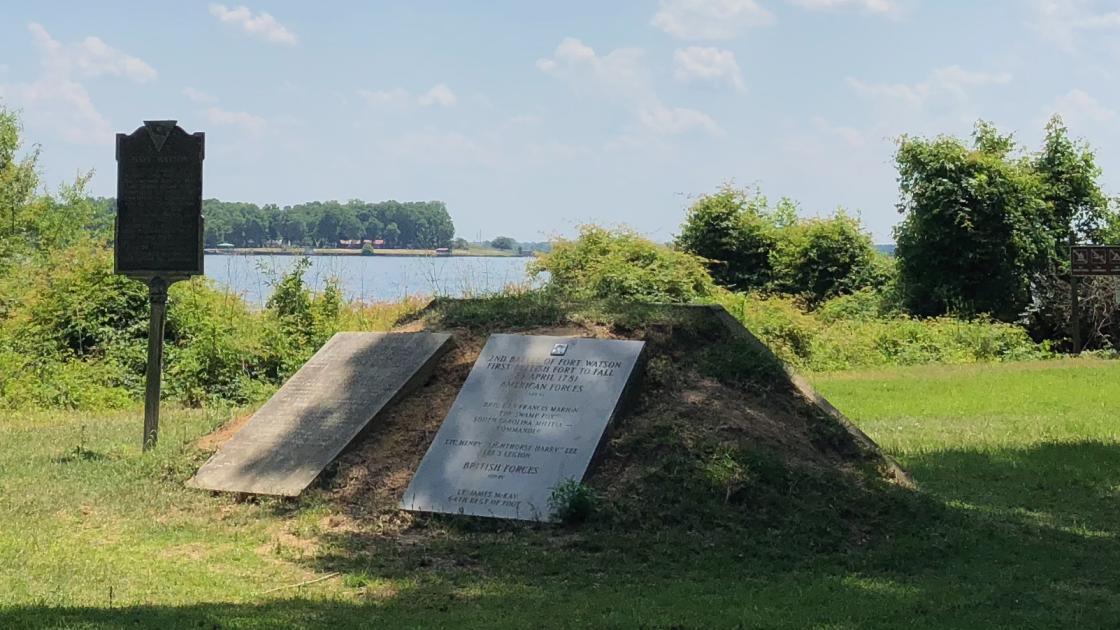
April 15- 23, 1781
Fort Watson, near Scott’s Lake and the Santee River, was part of a vital communication and supply network for the British during their occupation of South Carolina. After an eight-day siege here by Patriot forces under the command of Brigadier General Francis Marion and Lieutenant Colonel Henry Lee, this strategic outpost fell to the Americans, who used an ingenious structure called Maham’s Tower to fire down into the fort and trap the enemy.
Before You Go
Download the Fort Watson AR app to travel back in time to the American Revolution and to a pre-contact Santee Indian village with augmented reality. Download the free app for iPhone and Android here: https://www.battlefields.org/visit/mobile-apps/fort-watson-ar.
Fort Watson is located in the National Wildlife Refuge and offers both outdoor recreation pursuits and opportunities to learn about our cultural history. Make Santee NWR your destination to see wildlife, hike and bike, hunt, fish and enjoy boating. Visit the historic Santee Indian mound which was used as a British Garrison during the Revolutionary War.
Seasonal opportunities for hunting White-tailed deer are available at the Bluff, Cuddo, and Pine Island Units of the refuge. Hunters from all over the state come out to the woods of Santee in the hopes of harvesting a deer or feral hog. No alligator hunting or waterfowl hunting permitted within refuge boundaries. Be sure of your location and the refuge boundary when hunting on the waters of Lake Marion.
Both hunting and fishing are permitted, subject to state, federal and refuge regulations. Fishing and hunting regulations and permits are available at the refuge office and from our website at no cost to visitors. The permit must be signed and in you possession while conducting these activities on the refuge.
Plan to bring insect repellent during warm months and wear layered clothing during cool weather.
Visit the Santee National Wildlife Refuge website to learn more.
From Sacred Site to Battleground
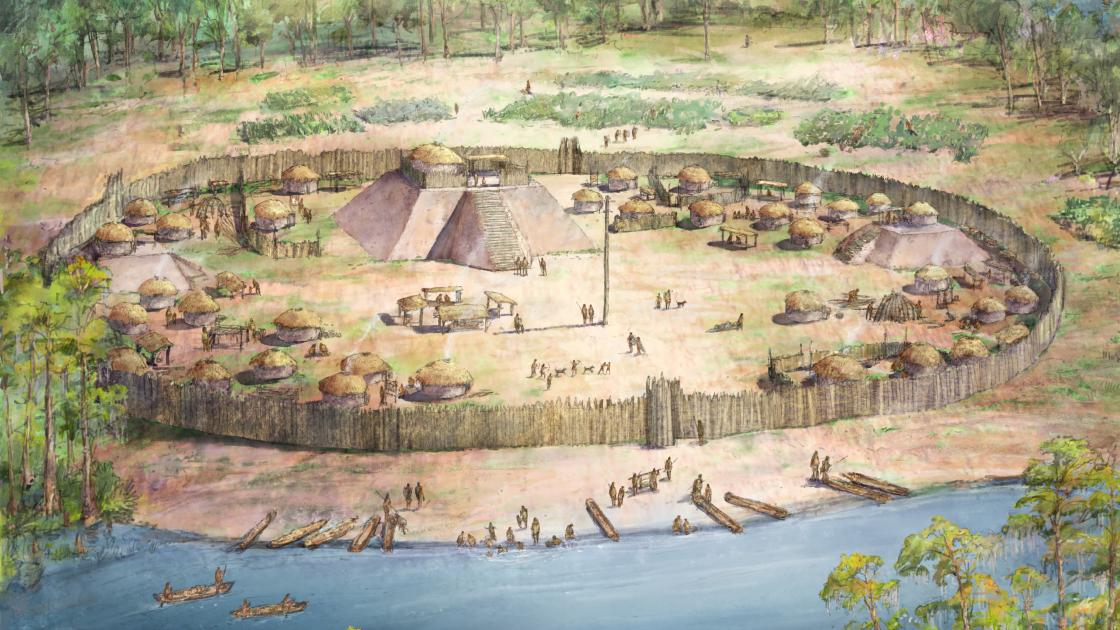
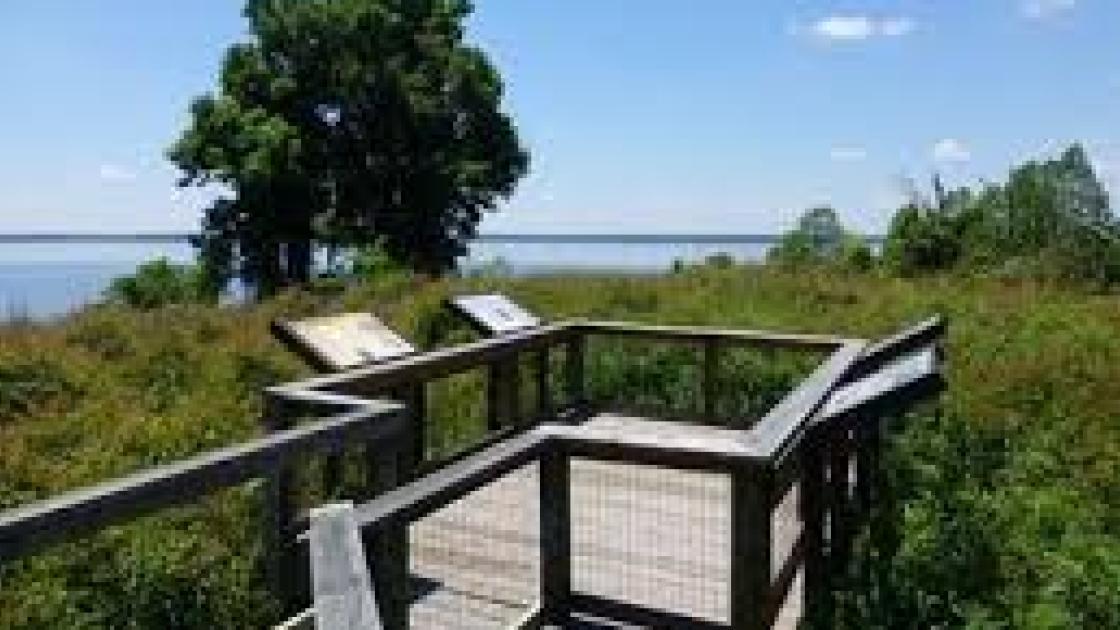
After you pass the Visitor’s Center at the Santee National Wildlife Refuge, it is a short ride along the shores of Lake Marion to the site of Fort Watson. There you will see a prehistoric ceremonial mound built by the Santee Indians, which became the scene of a siege during the Revolutionary War. The landscape you encounter today is very different from the forested wetlands inhabited by the Santee and occupied by the British. Lake Marion, a man-made body, was not created until the 1940s. Before then, this ground bordered on Scott’s Lake, an oxbow reservoir that connected to the Santee River. This strategic location on bluffs overlooking water benefitted not only theAmerican Indians who farmed, fished, and hunted in this region, but also the soldiers garrisoned here in the 18th century.
The Santee were part of the Mississippian culture that lived in this area for thousands of years. The mound itself is approximately 1,000 years old. Artifacts uncovered by archeologists here — ceramics, shells, and bone — reveal that the site held a temple that might have been part of a larger ceremonial center for the Santee centuries before the founding of Charleston. This mound was eventually abandoned by the American Indian population, whose numbers were gravely reduced by disease and death after contact with European settlers.
After the capture of Charleston in the spring of 1780, the British established rural outposts throughout the region to safeguard supplies and troops, and to tighten control over local rebels. This deserted ceremonial site was the ideal location for a fort because it provided an elevated vantage point that overlooked the ferry crossing on the Santee River and the road to Charleston. The mound was incorporated into a stockade built under the direction of Provincial Lieutenant Colonel John Watson of the British Army, for whom the fort was named.
Marion & Lee
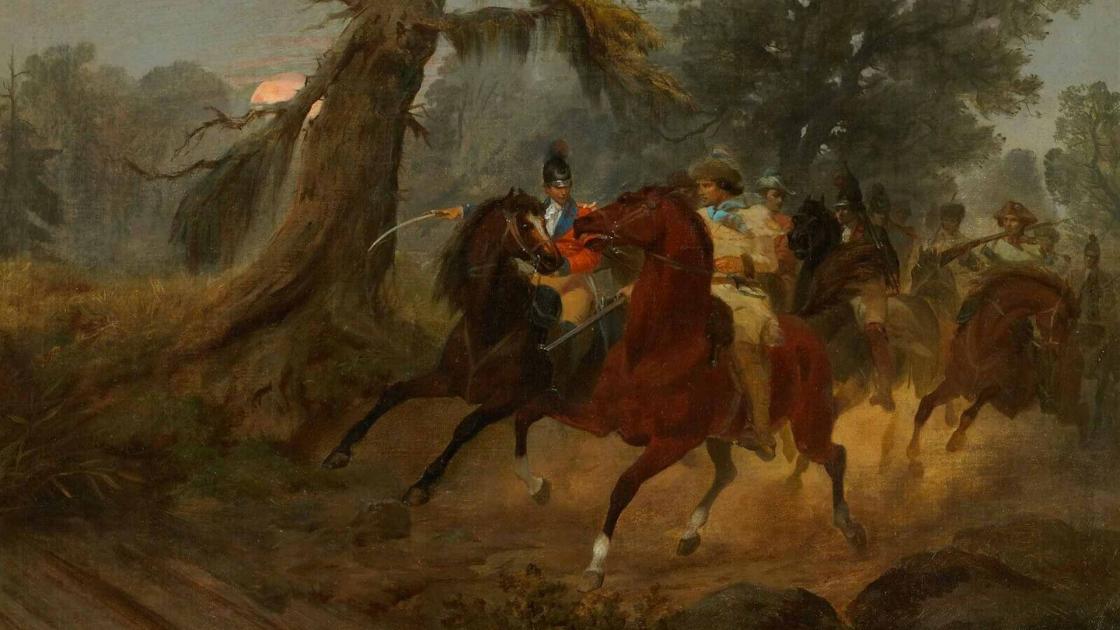
Around this part of the Santee, Patriot Brigadier General Francis Marion, known as “The Swamp Fox,” and his local militia were using guerilla tactics to harass British garrisons and earn support for American independence. British Lieutenant General Charles Cornwallis complained to his superior, Sir Henry Clinton, that “Col. Marion has so wrought on the minds of the people…that there was scarcely an inhabitant between the Santee and the Pedee, that was not in arms against us.” While the British attempted to suppress the elusive Marion, Patriot Major General Nathanael Greene employed him and his partisans to work with the Continental Army in defeating their formidable enemy.
In January 1781, Greene ordered Lieutenant Colonel Henry Lee to team up with Marion. “Light-Horse Harry” Lee was a tenacious cavalry commander and outfitted his own “Legion” during the war, but he is perhaps better known today for being the father of Civil War General Robert E. Lee than for his achievements during the Revolutionary War. Marion and Lee proved to be an odd couple. The dashing and outgoing Lee was only 25 years old in 1781, while the more reticent and disheveled Marion was 49, almost twice his age. Lee was born into the Virginia aristocracy and received an officer’s commission in the Continental Army; Marion was a hardened militia guerilla fighter who used his experience in the French and Indian War. Somehow, despite their differences, these two men forged a highly effective partnership. As Greene moved to reenter South Carolina in March 1781, after the Battle of Guilford Courthouse in North Carolina,, he engaged this duo to operate against the line of British forts between Charleston and Camden. Their first target was Fort Watson.
A Valuable Outpost
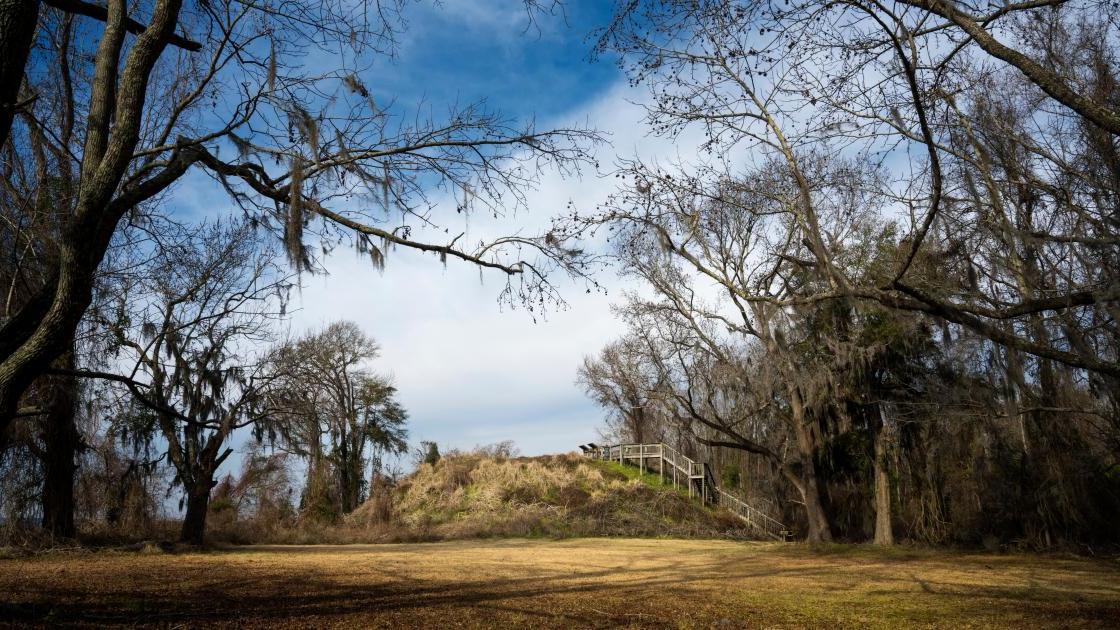
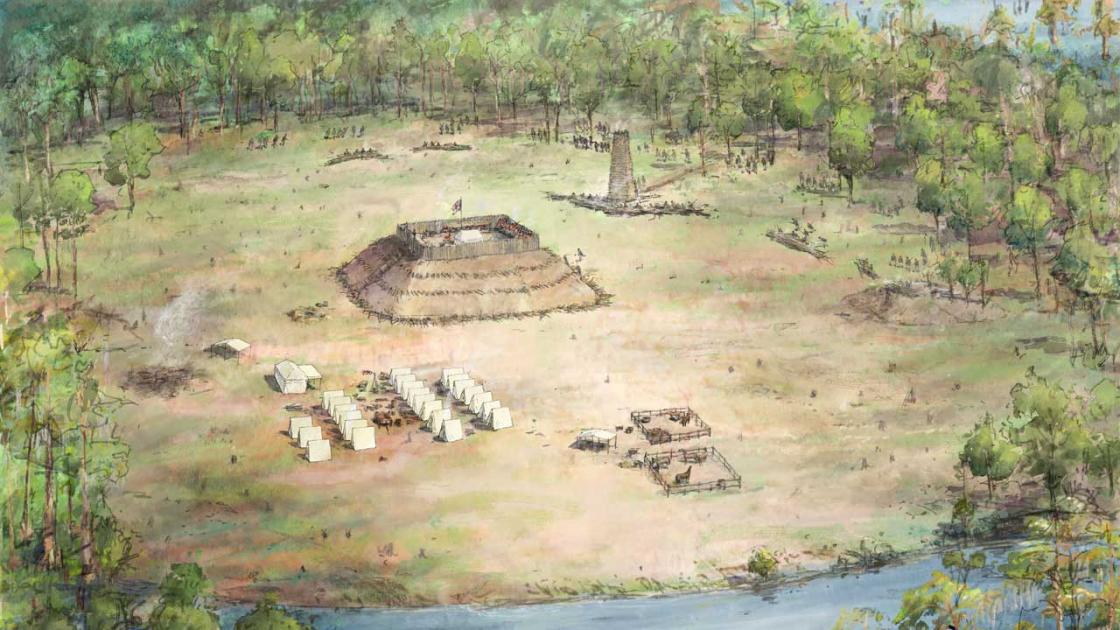
You can no longer see any trace of Fort Watson, but you can ascend the ceremonial mound, imagine how the Santee’s sacred temple dominated the landscape, and picture the British fort that sat on top. We know that the structure was 75 feet long, 50 feet wide and sat on top of the 23-foot mound. Lieutenant Colonel Watson wrote about the construction:
“…having found a place, supposed to have been the burying ground of their Indian Chiefs in former times, resembling the Barrows of this Country [England]; we escarpt'd it at Top, abattis'd it at the bottom and surrounded it as strong as the materials we could collect, and the only utensils we had, our Tomahawks, would admit.
Watson added a seven-foot-high stockade, constructed of logs, which made the fortification rise to 30 feet high. As he mentioned, the fort was also protected with three rows of abatis.
These sharpened logs and branches were pointed out toward an attacking enemy. This barrier was difficult for soldiers to penetrate, especially when under fire. Essential water for the troops was accessible from Scott’s Lake, and the camp, which lay outside the stockaded walls, was well provisioned.
In addition to being well defended and supplied, Fort Watson was in a prime location. Francis Marion proclaimed it “as strong a little post as could be made on the most advantageous spot that could be wished for.” From this base, British raiding parties could be deployed to escort convoys or to conduct counterinsurgency operations against the local Partisans. Only ten miles north of Nelson’s Ferry on the Santee River, the post provided a valuable link from Charleston on the coast to the British interior bases of Camden and Ninety Six, South Carolina. The Patriots were intent on taking and destroying this key British garrison.
The Siege Begins
In April 1781, Watson was away from camp on a mission to track down and defeat Marion. After that failed mission, he and his select units marched to reinforce the British station at Camden. In Watson’s absence, command of Fort Watson fell to Lieutenant James McKay, who held the post with 125 men. Meanwhile, Lee and Marion joined forces on April 14. Knowing Watson was away from base, it seemed like an advantageous time to attack his garrison. On April 15, the combined Patriot force of about 400 surrounded the fort and began a siege. In keeping with the formal rules of war, they demanded that McKay surrender the post. McKay, however, felt the fort’s solid defenses could withstand an attack and decided to hold off the Patriots until reinforcements arrived.
The Patriots’ first act was to cut off the fort’s access to water by guarding Scott’s Lake and the nearby river, but they soon discovered that the garrison dug a well next to the mound. Unfortunately, the Patriots had no artillery, so they could not force the surrender of the fort. If they had guns, Lee wrote to Greene, “This post could be reduced in five moments.” To add to their woes, some of the men in Marion’s camp came down with smallpox, which caused fear and desertions. As the siege progressed, the Americans were hampered in their efforts to construct their own fortifications as they lacked the tools to dig trenches. Running low on ammunition and morale, the commanders were desperate for a breakthrough by the end of the first week. Then, Major Hezekiah Maham made a novel proposal. Marion wrote to Greene: “…as we had no entrenching tools to make our approach, we immediately determined to raise a work equal to the height of the fort.”
Maham's Tower
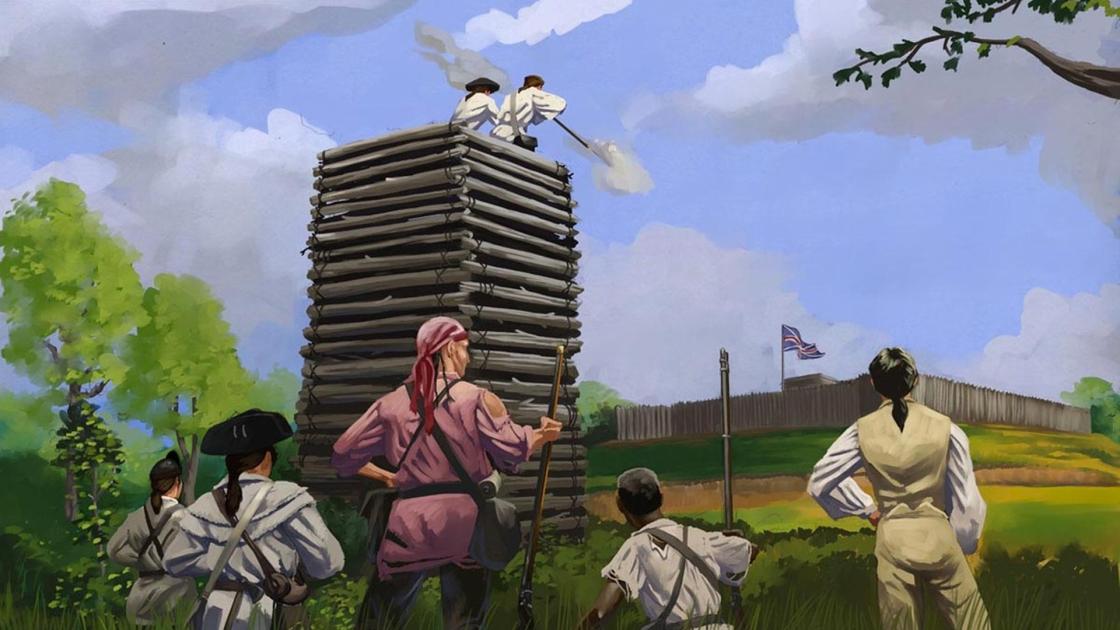
At this low point in the siege Major Hezekiah Maham, who served under Marion’s command, presented an innovative idea to help force the surrender of Fort Watson without an assault on the works. He proposed the construction of a wooden siege tower, like ones employed in Roman warfare, which would rise higher than the British stockade — some 30 to 40 feet — and allow riflemen positioned on top to fire down into the fort’s exposed defenders. The tower would be a log crib, made of pine timbers collected from the nearby woods. It would be rectangular in shape and mounted with a protective firing platform from which sharpshooters could direct their fire. Marion quickly approved this strategy and dispatched foraging parties to nearby plantations to appropriate the necessary tools to build the structure.
By dawn on April 23, the tower was ready. It may have been kept in the surrounding pine forest until it was finished and then rolled on logs toward the fort. Inside the fort, the besieged could do nothing to impede the Patriot plan. Lee later wrote: “A party of riflemen, being ready, took post in the Maham tower the moment it was completed; and a detachment of musketry, under cover of the riflemen, moved to make a lodgment in the enemy’s ditch, supported by the Legion infantry with fixed bayonets.
Patriot riflemen kept the British pinned down from above as other Patriots started dismantling the abatis protecting the British defenses. McKay and others were wounded, and the garrison was trapped. With all hope gone, McKay’s men refused to continue the fight. Though not a new concept in siege warfare, the Maham Tower, as it came to be known, was a stroke of brilliance. It saved the day for the Patriots at Fort Watson and would be employed again at the sieges of Augusta and Ninety Six later in the year.
The Surrender
On April 23, McKay, now wounded twice and realizing the hopelessness of his situation, consented to surrender:
“The Enemy having finished their Entrenchments under cover of their Fire made a lodgment under our Works, with the intention to Undermine us. A flag was a second time sent to Summons the Post, when we were reduced to the disagreeable necessity of Capitulating, . . .
The Patriots destroyed the fort and took valuable ammunition. They also captured 5 officers, 73 Regulars, and 36 Loyalists.
On April 24, Greene wrote to Marion in admiration:
When I consider how much you have done and suffered, and under what disadvantage you have maintained your ground, I am at a loss which to admire most, your courage and fortitude, or your address and management…To fight the enemy bravely with a prospect of victory is nothing; but to fight with intrepidity under the constant impression of a defeat, and inspire irregular troops to do it, is a talent peculiar to yourself.
The Patriot success at Fort Watson proved that Continental and militia troops could be an effective unified force. This was the first British outpost to fall to the Patriots after the Siege of Charleston and it paved the way for future victories at Fort Motte and Fort Granby. The loss of this strategic outpost was a blow to the British. It broke a critical link in their supply and communication chain in South Carolina. Despite Greene’s later defeat at the Battle of Hobkirk Hill (April 25, 1781), the surrender of Fort Watson helped prompt British Colonel Lord Rawdon to evacuate the important operational British base at Camden. Other rural outposts were gradually abandoned as well, and the British were eventually pushed back to the Lowcountry around Charleston where they remained until they left the port city and South Carolina.