-
The BlogBiographies
-
Videos

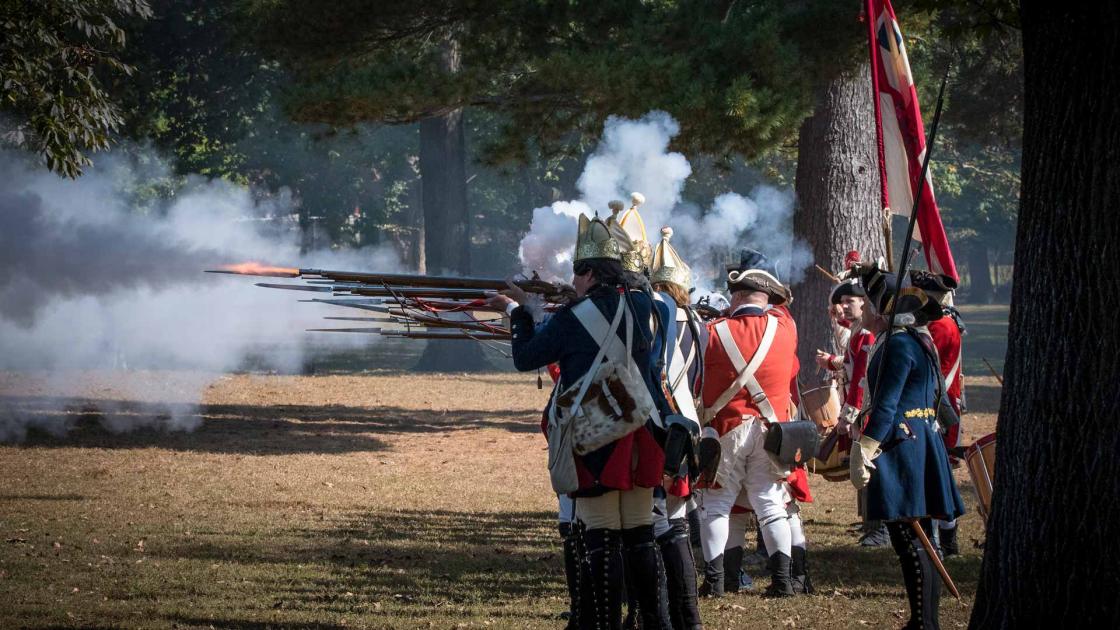
October 22, 1777
“The post with which you are entrusted is of the utmost importance. . . The whole defense of the Delaware absolutely depends on it.” General George Washington to Colonel Christopher Greene
“Colonel Greene…sends his compliments and he shall await Colonel Donop.” Colonel Christopher Greene
It’s October 22, 1777.
Three weeks ago, British troops marched into Philadelphia and now occupy the very birthplace of America’s call for independence. Imagine you are a Patriot here at Fort Mercer, a small but critical Patriot stronghold on the Delaware River. Your brothers-in-arms are across the water at Fort Mifflin and together, your mission is to block British naval advances into Philadelphia. The British occupy it now, but their hold is weak unless they control the river, too. Without access to the river to supply their troops occupying the city, the British hope of holding Philadelphia would be short-lived—and they know it.
And that’s where you come in.
A unique and determined force of about 400 Americans must band together here, including over 50 African American and Indigenous soldiers from the 1st and 2nd Rhode Island Regiments. You’re about to face one of the most fearsome forces the enemy can deploy. The Patriot commander here, Colonel Christopher Greene, has just received a hot tip==over 1,500 Hessians, are heading your way. Their commander, Colonel Carl von Donop, is rumored to have confidently proclaimed, “either that [Fort Mercer] will be Fort Donop or I shall be dead.” He’s willing to give his life in the battle for Fort Mercer.
Would you?
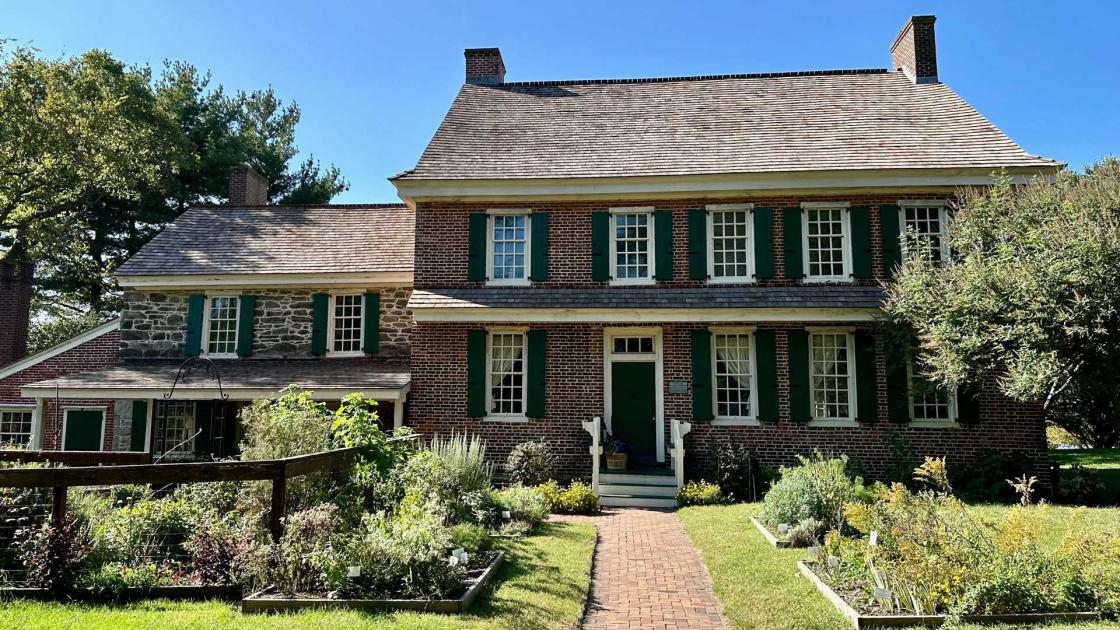
Whitall House
The American Revolution brought fierce fighting and bloodshed to doorsteps just like this one. It’s hard to imagine now on this peaceful landscape, but as the short but fierce Battle of Red Bank waged on October 22, 1777, cannon blasts shook the walls of this farmhouse. The Whitalls built this home in the 1740s in the middle of a vast 400-acre plantation. Look up at the gable end of the house and find the couple’s initials and the date “1748” outlined in brick. The family’s Quaker belief in pacifism may have kept them from fully participating in the American Revolution, but nothing could stop war from coming to them. Patriots claimed much of their property to construct Fort Mercer just 600 feet north of their home. James alleged that Patriot Colonel Christopher Greene confiscated their hay and wheat, cut down 300 apple trees, tore down a barn and hay house and did further damage amounting to the tune of five thousand, seven hundred and sixty pounds sterling—and one shilling. James issued a bill to the New Jersey legislature for damages rendered, but was never paid.
And then the battle came. What would you have done if war waged around your home?
If the stories are true, Ann Whitall defiantly remained inside this house, busy at her spinning wheel.
The legend goes like this: before the Hessians arrived to attack Fort Mercer, Ann and her family packed their valuables and headed out of town for safety, but something made Ann turn back. And something made her stay. As cannon balls began to fly and battle waged around her, Ann remained calm at her spinning wheel, unshaken—that is, until a cannon ball flew into the north gable end of the house, rolled downstairs, and into her spinning room. Only then did Ann leap up and seek safety in the basement. Take a moment to explore the grounds around the house—there’s no evidence that a cannon ball breached the roof or walls here, and even less evidence that this legend of Ann’s steadfastness is true.
Ann’s legendary tenacity may have persisted well after the battle, as her home transformed into a field hospital for wounded Hessian soldiers—she’s rumored to have admonished the fearsome Hessians for their war-waging career choices.
Legends aside, the Battle of Red Bank and its aftermath wreaked havoc on James and Ann Whitall’s property.
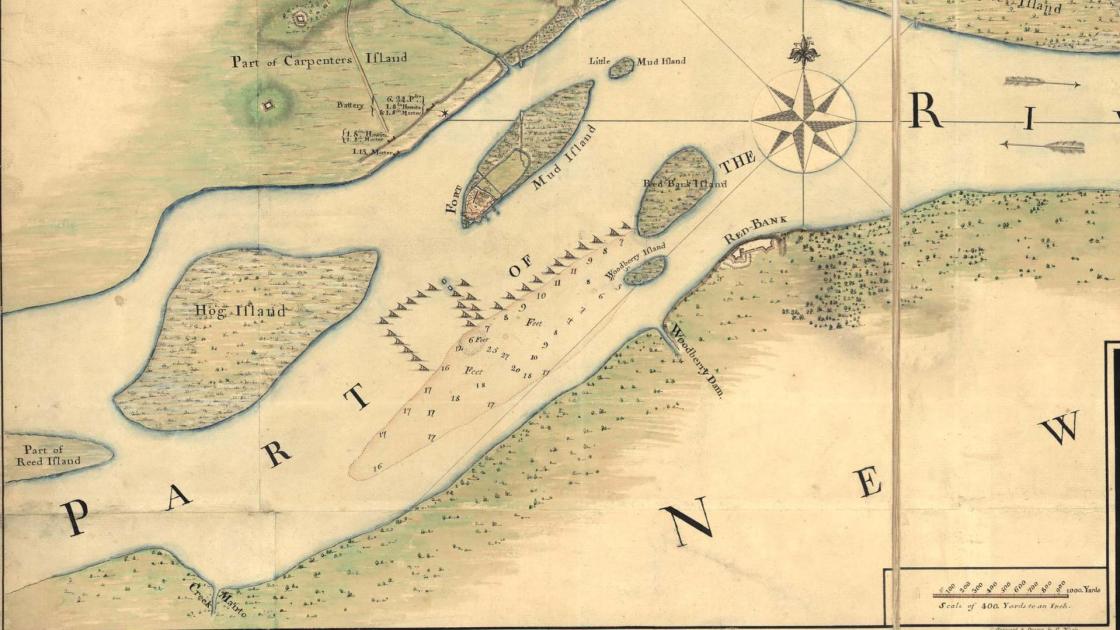
Those aren’t just old logs you’re looking at—you’re looking at actual remnants of chevaux de frise that wrecked havoc on the British ships that once trolled Forts Mercer and Mifflin from the Delaware River in 1777. What is chevaux de frise you may ask? It’s an ancient method of defense, created by arranging large timbers with tips whittled into sharp spikes. The term literally means “horses of Friesland,” referring to the Northern European Frisians who waged cavalry warfare. On land, these obstacles would deter a cavalry charge, but deployed underwater, these spiked obstacles could pierce the hull of an enemy ship or run them aground. Patriots constructed these protruding obstacles and sunk them strategically in the Delaware Riverbed to prevent British supply ships from navigating safely upriver to their foothold at Philadelphia. Patriots constructed Fort Mifflin (on Mud Island) and Fort Mercer (in Red Bank) to protect these critical underwater defenses. For a while, it worked.
The chevaux de frise between Mud Island and Red Bank appear on a 1777 map of the Delaware River.
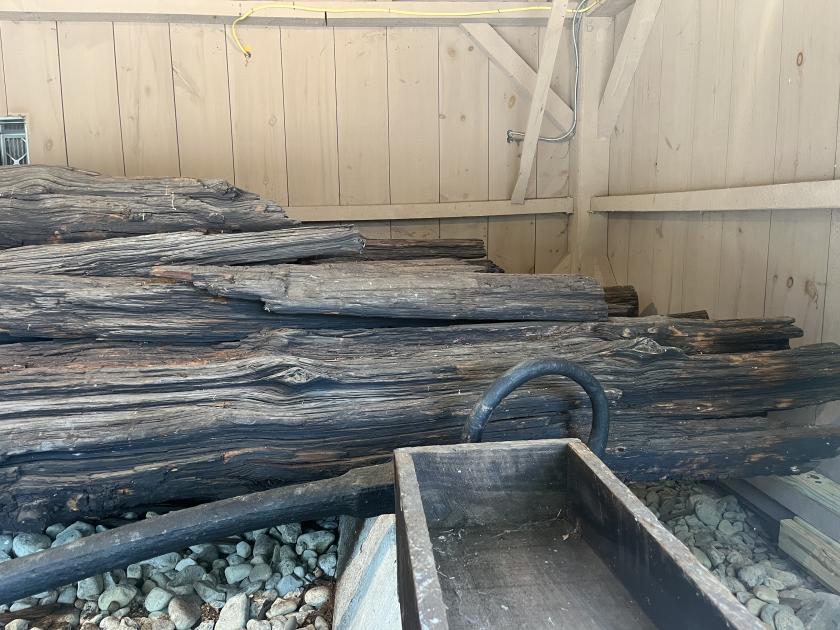
Remnants of the original chevaux de Frise from the Delaware River
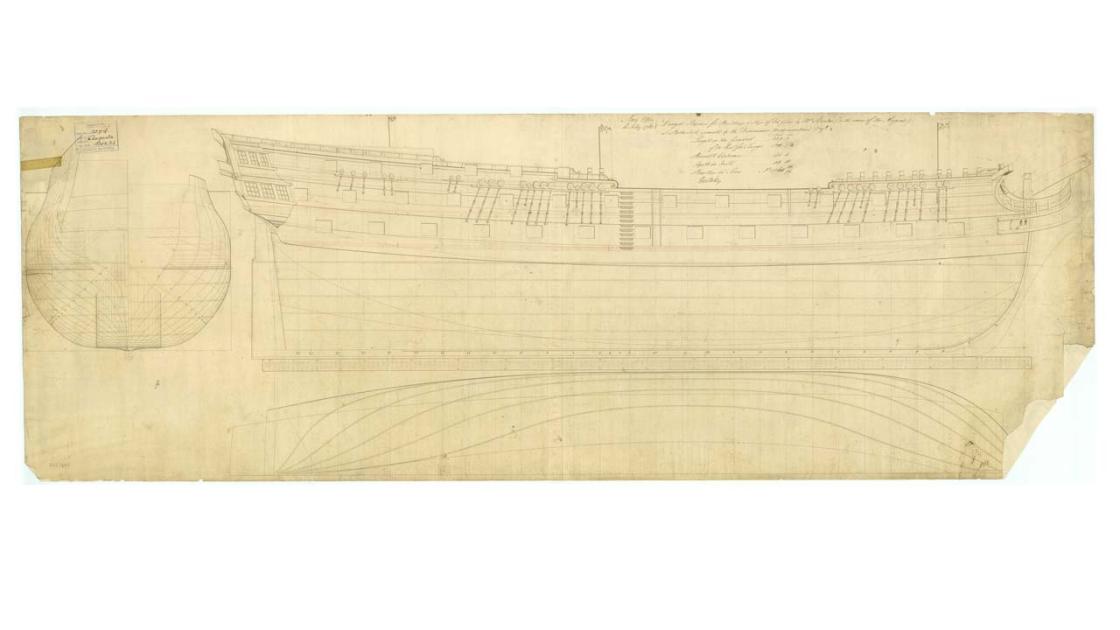
Burst HMS Augusta Cannon
As the Battle of Red Bank waged on land on October 22, 1777, British warships slithered into place in the Delaware River, ready to fire upon Patriot positions. But the ships had to navigate the obstacles of the chevaux de frise, or risk becoming ensnared among them.
During the battle, the massive 64-gun HMS Augusta ran aground and became trapped. Suddenly, a fire erupted. By the next day, the fire reached the Augusta’s powder stores and exploded spectacularly with a blast heard over 10 miles away. One eyewitness, Captain John Montressor, saw that “many of the seamen jumped overboard…but the Chaplain, one Lieutenant and 60 men perished in the water.” When the smoke had cleared, Patriots attempted to salvage what they could from the frigate, including cannon and swivel guns.
Archaeologists identified this cannon as one salvaged from the smoldering wreckage of the HMS Augusta. While it survived the explosion on October 23, when Patriots attempted to fire it weeks later it, too, burst into flames. Patriot Sergeant John Smith of the 1st Rhode Island Regiment recorded in his diary that on November 11, as Patriots here were unleashing a cannonade on a British flotilla in the Delaware, “we split an 18-pounder which was taken out of the wreck of the Augusta who was burnt in this river the 23rd of October—killed Benjamin Ross, the bombardier and wounded the Boatswain…and put out one of his eyes and wounded one or two others slightly.” Read the nearby interpretative sign to learn more about the archaeology that discovered this cannon.
Did you know---you can visit the HMS Augusta in Washington, D.C.! Well, sort of—when remnants of the ship were found in the river in 1876, the wood was converted into a furniture suite, which is on display in the New Jersey Room at the D.A.R. Museum!
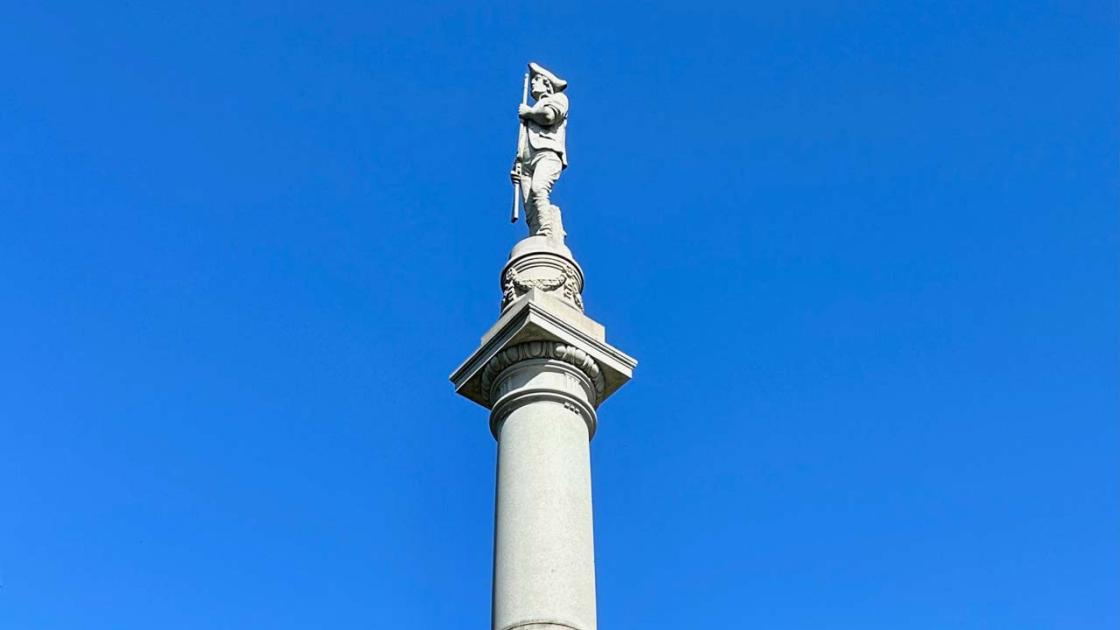
1906 Monument: Battlefield to Park
The monument erected here stands within the bounds of the original Fort Mercer. As workers excavated the property prior to the monument’s installation, they uncovered two cannon, grape shot, an iron camp stove, and other artifacts of the battle.
As you explore the grounds here, you might be wondering how this landscape went from bloody battlefield to public park. This monument, dedicated in 1906, is a good place to tell that story.
The Quaker Whitall family, the original owners of the 400-acre tract here, were never compensated for the wartime destruction of their property. In 1872, a subsequent owner sold 100 acres to the Army Corps of Engineers. In 1900, as the country celebrated its quasquicentennial—its 125th anniversary—monuments dedicated to the memory of Revolutionary battles began to spring up around the country. Finally in 1903, 126 years after the pivotal Patriot victory here, a plan was formed to set aside lands to honor the Battle of Red Bank. President Theodore Roosevelt signed an act to create a 20-acre park here. The New Jersey Legislature set aside $15,000 to erect the monument that stands before you, which was dedicated on June 21, 1906.
Look up at the Patriot soldier that stands atop the monument. He doesn’t look like a lot of the soldiers who actually fought here. At least 48 Patriots were of African or Indigenous descent, members of the integrated 1st and 2nd Rhode Island Regiments. These Patriots served with great distinction, though history has been slow to remember their service here. While this 1906 monument does not acknowledge or reflect the presence of Black or Indigenous soldiers, the Park is working to amend this monument to tell a fuller story of the Patriots here at Red Bank.
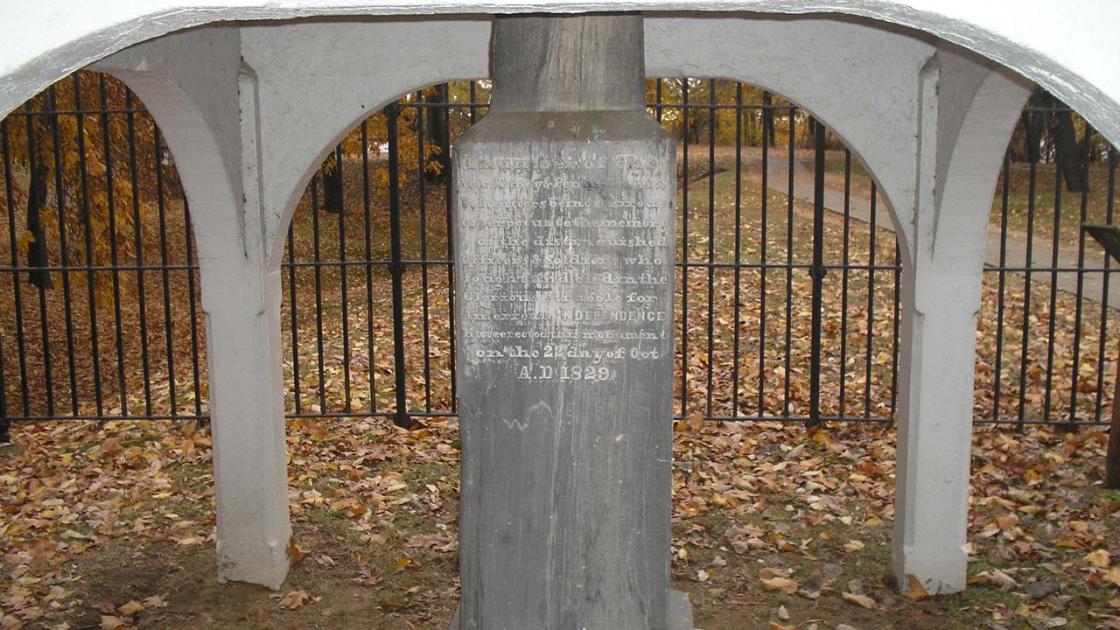
1829 Monument
You’re looking at what historians believe may be the 3rd oldest Revolutionary War monument in the country. The inscription reads, “This monument was erected on the 22 Oct 1829 to transmit positively a grateful remembrance of the patriotism & gallantry of Lieutenant Colonel Christopher Greene who with 400 men defeated the Hessian army of 2000 troops then in the British Service at Red Bank on the 22nd Oct. 1777. A number of the New Jersey and Pennsylvania Volunteers being desirous to perpetuate the memory of the distinguished officers and soldiers who fought and bled in the glorious struggle for American Independence have erected this monument.”
In the 19th century, this battlefield became an important and popular destination for African Americans, especially members of the Mother Bethel AME Church in nearby Philadelphia. They came to pay their respects to the African Americans who fought here.
At least 48, maybe as many as 60 soldiers who fought here were of African or Indigenous descent. These soldiers served in the integrated 1st and 2nd Rhode Island Regiments. At the time this monument was erected, there wasn’t much acknowledgment of the people of color who served in the battle here. In fact, there wasn’t much acknowledgment of people of color serving in the American Revolution at all. William Cooper Nell, an African-American abolitionist from Massachusetts, worked hard to change that. He wrote the first history of African Americans in the Revolution, published in 1855. “The glory of the defense at Red Bank,” he wrote, “which has been pronounced one of the most heroic actions of the war, belongs in reality to black men.”
Many of the African American and Indigenous soldiers who served here continued to serve in the American Revolution. The two regiments merged later in the war as the 1st Rhode Island Regiment. They contributed to the Continental Army’s victory at the Siege of Yorktown in 1781, which brought about the end of the war.
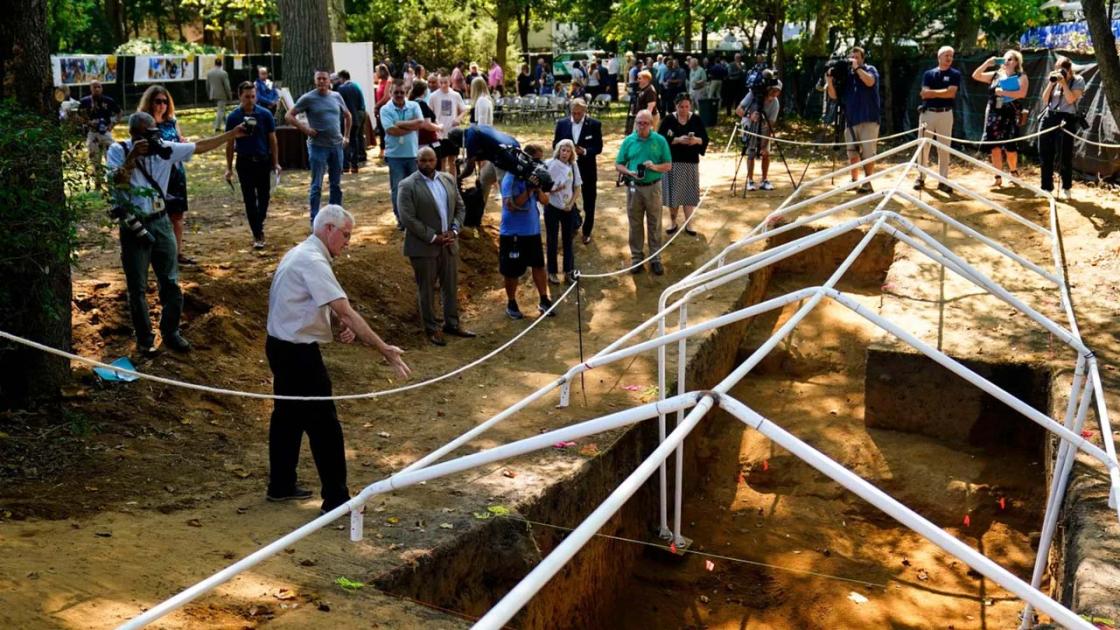
Hessian Burials
In this field archaeologists uncovered the remains of 15 Hessian soldiers who died here at Fort Mercer in 1777. They were buried in a trench here outside the original bounds of the Fort after one of the Hessians’ most shocking and unexpected defeats of the Revolutionary War.
The Battle of Red Bank, fought between 1,500 Hessian soldiers and 400 integrated American troops, was an unlikely and shocking defeat for the professional soldiers. How could so few Patriots defeat such a meager fort against so many of the fiercest enemy? Hessian Captain Johann Ewald attributed the disastrous loss here to many technical errors and lapses in judgement. He laid blame on Hessian Colonel Carl von Donop, who was so confident in victory that he opted to summon the fort upon their arrival, instead of immediately attacking with the element of surprise. In summoning Patriot Colonel Charles Greene, von Donop essentially offered an advance ultimatum: surrender, or prepare for attack. The Patriot reply? “Colonel Greene…sends his compliments and he shall await Colonel Donop.”
At the end of the short afternoon battle, the Patriots suffered just 37 casualties (14 killed, 23 wounded). The Hessians suffered as many as 400--including the defiant Colonel Carl von Donop who was mortally wounded and succumbed days later.
In his wartime diary, Captain Ewald wrote “This day was especially sad for me. I lost five of my oldest friends, among whom was a relative, and four of my best friends were severely wounded. As long as I have served, I have not yet left a battlefield in such deep sorrow.”
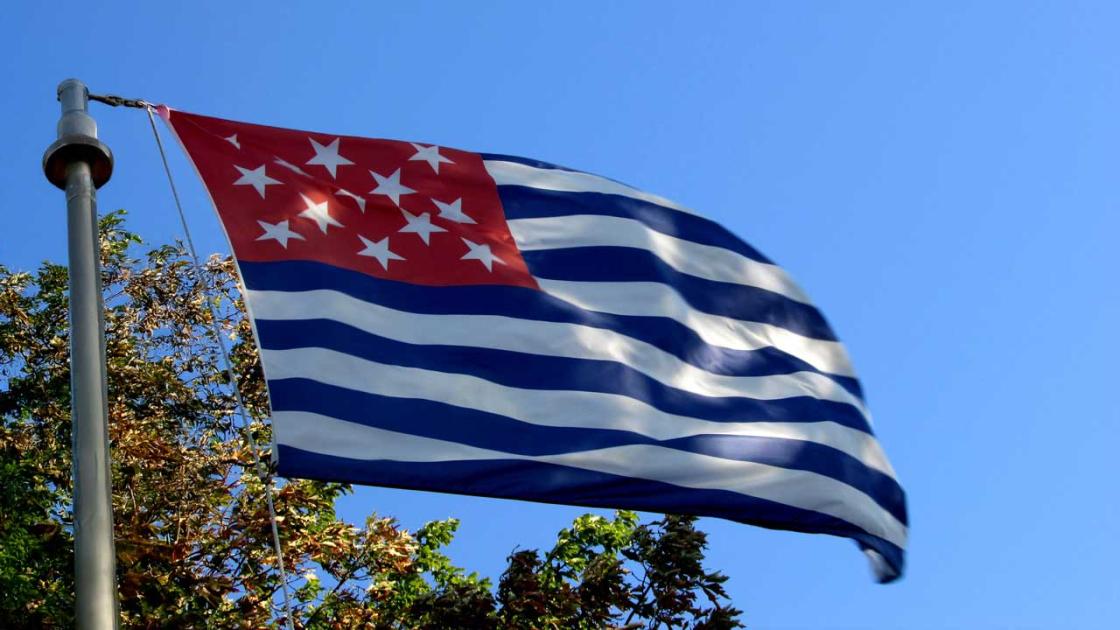
Fort Mercer Garrison Flag
Heads up! The flag flying above you might not look like the traditional Stars and Stripes that you’re used to, but the symbolic elements of the united colonies are all there—13 stars wave in a field adjacent to alternating thirteen stripes, each standing for the new states proclaiming independence from Great Britain. You’re looking at a replica of the flag that flew here at Fort Mercer, thanks to 18th-century watercolor maps that show it in detail. But why does it look so…different?
The fortification of Red Bank--what became Fort Mercer—began in spring 1777. Engineers, sappers, and miners began building earthworks and staging abatis in strategic locations—helping themselves to lumber courtesy of James Whitall’s apple orchard. Construction continued for months, lasting even until a few hours before battle erupted here. Talk about cutting it close.
Back to the flag—every fort needs one. On October 18, one patriot soldier here noted in his diary: “The American Flag was this day hoisted at Red Bank.” So why does this flag look so different from the American flag we’re used to? The Stars and Stipes design was codified on June 14, 1777—we know it as Flag Day today. The important elements are all still evident on the Fort Mercer flag, it’s just a simple inversion of the color pallet—and historians aren’t sure why.
But this flag is more than just colors waving in the wind. It’s a rallying cry. And the patriots here at Fort Mercer—including the integrated ranks of the 1st and 2nd Rhode Island—were fighting for what those stars and stripes stood for—life, liberty, and pursuit of happiness.
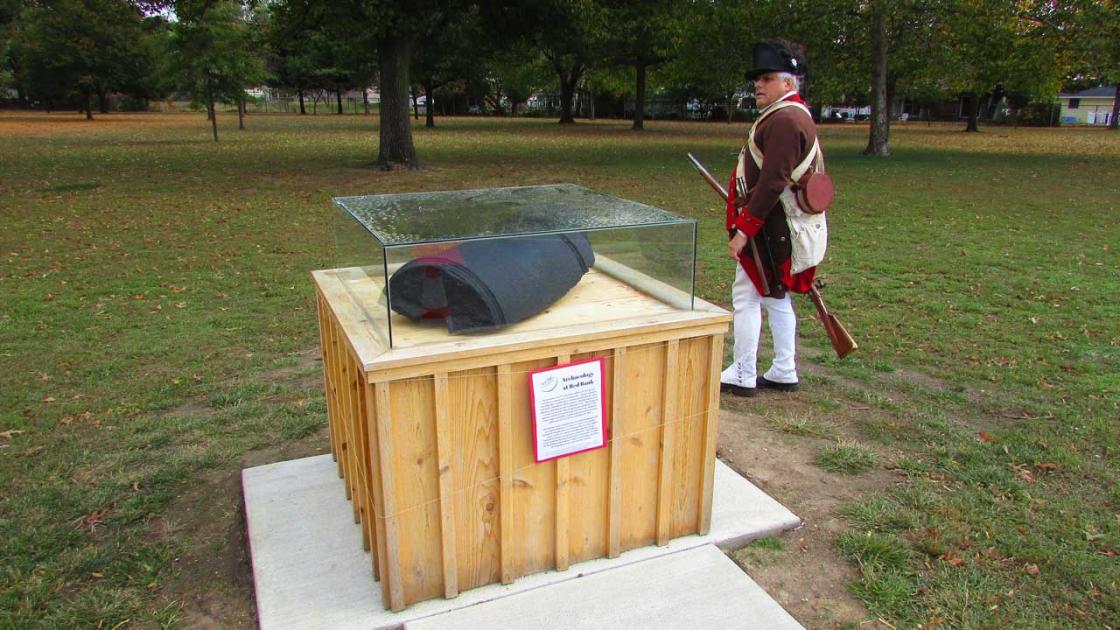
British Cannon
You’re now standing along the side of the original outlines of Fort Mercer, marked by this cannon. And from this vantage point, you’ve gotten a lot further than many of the Hessians who stormed the Patriots here on October 22, 1777. Though too few men defended the position here, Fort Mercer’s obstacles proved treacherous for the advancing enemy. The Hessians were slowed and trapped by ditches, earthen redoubts, and sharp abatis, or what Hessian Captain Johann Ewald called “assault stakes.”
Ewald lamented after the battle that “no one thought about axes or saws with which the obstructions and palisades could be cut down.” Patriot Jeremiah Greenman remembered the scene: “the artillery and musketry of the fort [caused] great slaughter [as] they advanced as far as the abatis, but they could not remove it (though some few got over) being repulsed with great loss.”
Similarly, Patriot Captain Stephen Olney recalled that Patriot fire from the fort down into the pinned Hessian line “proved so destructive” that the enemy “gave it up and retreated, leaving their dead and wounded.” The Hessian defeat here was a shocking upset, the Hessian commander Colonel Carl von Donop had confidently proclaimed “either that will be Fort Donop or I shall be dead.” In less than an hour it was all over—and Colonel Donop lay among the fallen.
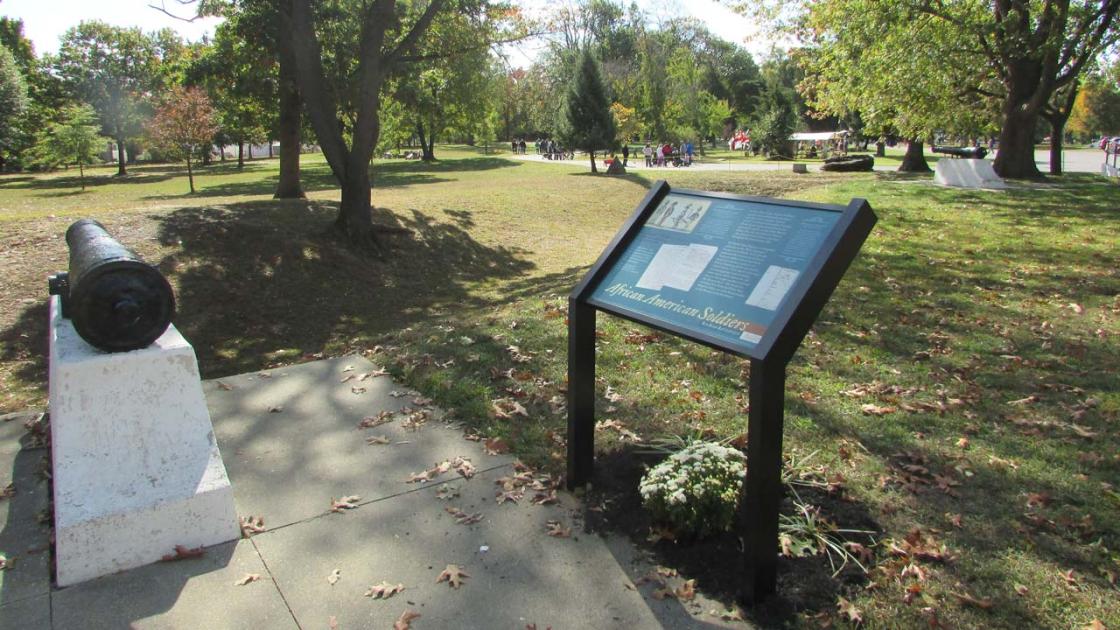
African Americans at Red Bank
The Patriot victory here at Red Bank would not have been possible without the efforts of the 1st and 2nd Rhode Island Regiments. At the time of battle here, these Rhode Island units were integrated. Their ranks included soldiers of African and Indigenous descent. At least 48 people of color served here, and their presence at Fort Mercer is one of the earliest examples of integrated units in the Revolution.
When the 1st Rhode Island Regiment arrived here on October 11, followed by the 2nd Rhode Island Regiment on October 18, they were immediately assigned to build new and strengthen existing defenses. If you’ve ever dug a ditch or built a fence, you know that it was hard labor and dirty work—especially without modern power tools! The regiments worked around the clock to secure the Fort here, expecting an imminent attack. Indeed, the Regiments completed the improvements to Fort Mercer mere hours before the Hessians arrived. It was their efforts that laid the groundwork for the Patriot victory.
During the American Revolution, Rhode Island offered freedom to enslaved men who joined the military. While most of the African-American soldiers who fought here were already free, at least one, Prince Vaughn, was not. Enslaved in North Kingston, Rhode Island, Prince enlisted on July 18, 1777. He may have been just 15 years old when he saw battle here at Red Bank. From here, Prince went on to serve for the duration of the war, being discharged in 1783. In exchange for his service, the state of Rhode Island gave Prince his freedom.
Read the interpretive panel here and learn more about people like Prince Vaughn, who fought here not just for the freedom of a country, but for their own freedom, too.
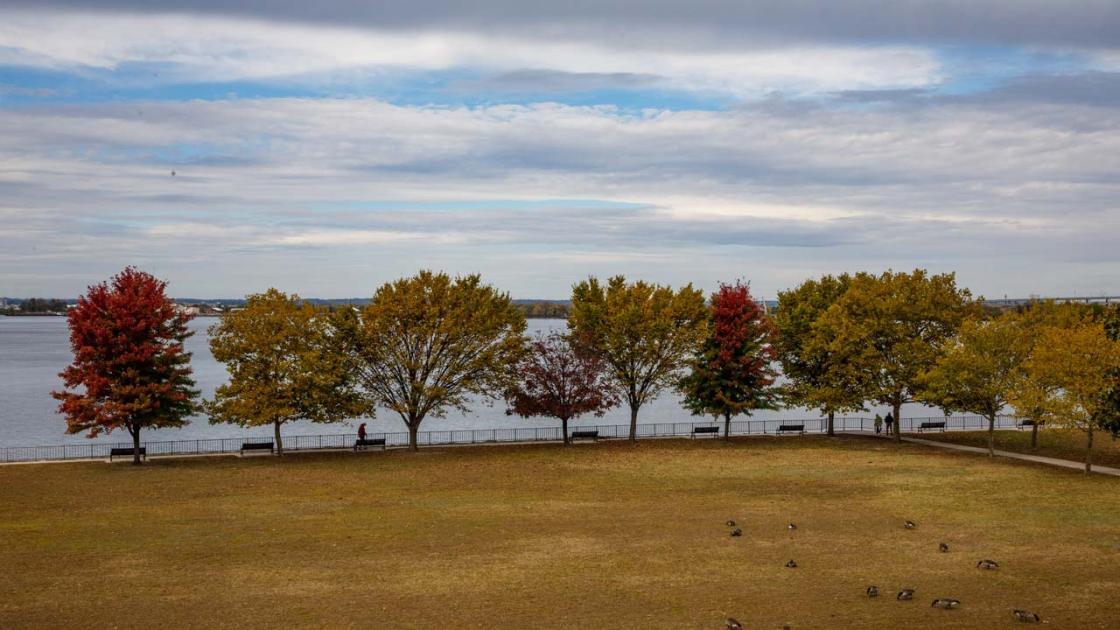
Delaware River
The river looks a lot different today than it did in 1777—it’s much wider now, and the viewshed then would have been Fort Mifflin, not the Philadelphia International Airport and double-decker overpass! But erase all that and travel back to 1777.
Control over this river is exactly what the battle here at Red Bank is all about. It’s why Patriots worked day and night to make Fort Mercer impenetrable to Hessian troops. And it’s what the British need most if they want to keep occupying the Revolutionary city itself—Philadelphia.
Remember those old logs you saw in Stop 2, found archaeologically in the Delaware River? The Pennsylvania Navy used those logs—which are actually called chevaux de frise, to lay a trap for any British man-of-war that dared to sail upriver. Beneath the waters, the navy sank upwards of 80 wooden frames linked together with chains and filled with those chevaux de frise. Those sharp, pointed logs would ensnare any enemy ships approaching the forts.
Imagine the HMS Augusta floating in the river here. It’s a 64-gun frigate and it’s the second largest ship in the whole of the British fleet. This is its maiden voyage. It’s mission? Support the British attacks on Fort Mercer and Fort Mifflin, and claim the Delaware River for their side
As the sun went down on October 22, 1777 the main action on land at Fort Mercer was over, but the American and British navies were waging their own battle in the river. Word arrived that the Hessians were defeated at the Fort, and when the Augusta attempted to disengage, the massive ship ran aground. The trapped ship caught fire, and when the flames finally reached its powder stores, the resulting explosion was so grand and so loud that it could be heard across the river in Philadelphia—perhaps a fitting ending to a shocking but spectacular Patriot victory at Red Bank.