-
The BlogBiographies
-
Videos

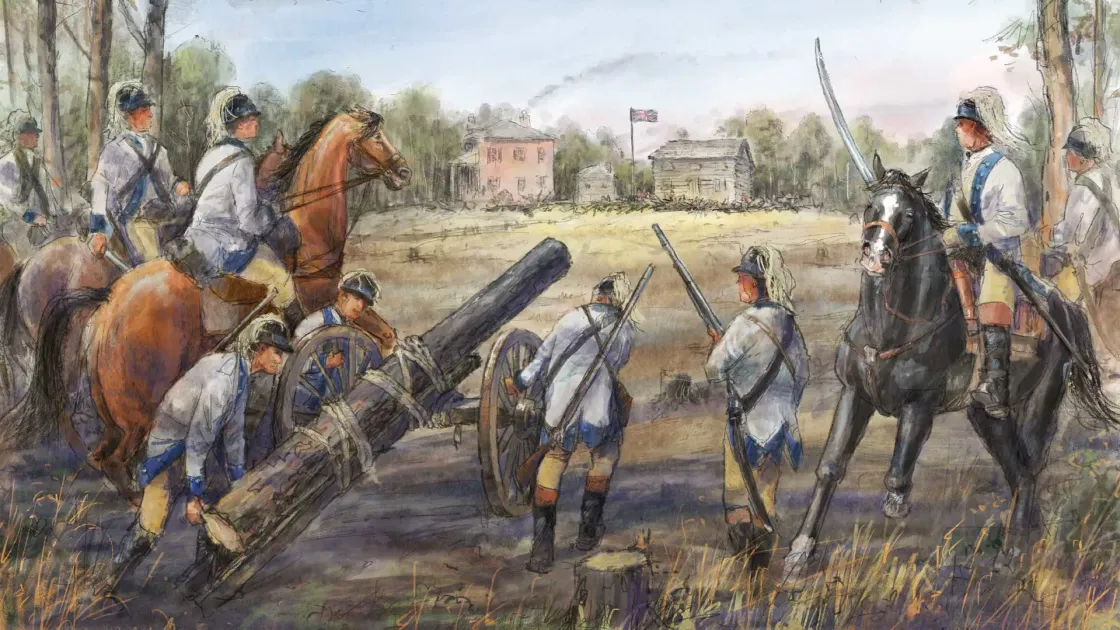
December 1 - 2, 1780
At first glance, this unassuming stretch of ground gives little hint of the drama it once witnessed. Yet here stood Rugeley’s Mill, a bustling trading post and fortified outpost where armies crossed paths, loyalties blurred, and survival often outweighed ideology. In the shifting world of Revolutionary South Carolina, this place embodied the uncertainty and quiet intrigue of a war fought between neighbors.
An Ingenious Patriot Deception Provokes a Prominent Loyalist to Surrender His Outpost
This empty ground near the intersection of Flat Rock Creek and Granny’s Quarter Creek, was once the site of Rugeley’s Mill (also called Rugeley’s Fort), located on the property of Clermont Plantation, the estate of prominent Loyalist Colonel Henry Rugeley. Rugeley commanded a regiment of the Camden militia and also ran a busy trading post here, which offered local goods and served as a rendezvous point for both armies — Patriot and British. Despite his commitment to the British cause, Rugeley, like many Americans, had shifting loyalties. When South Carolina Governor John Rutledge fled here to shelter after the May 12 surrender of Charleston to the British, Rugeley warned him that British Lieutenant Colonel Banastre Tarleton was coming after him and allowed the governor to escape.
Rugeley repurposed a barn on his estate as a fortress. Built of strong logs, it was surrounded by abatis (sharpened tree branches) and a ditch. This Loyalist stronghold became the target of a bizarre Patriot raid by Lieutenant Colonel William Washington, a cousin of George Washington, and his dragoons on December 1, 1780. When Washington’s forces arrived, Rugeley was inside his fortified base with eight officers and 104 Loyalist militia. Washington had no artillery to capture the impregnable structure, so he came up with a clever plan. He fashioned a “Quaker gun” by making a fake cannon out of an ordinary pine log, and then moved it into full view of the Loyalists. Amazingly, the ruse worked. Rugeley promptly surrendered the post, including all the officers and enlisted men. The Patriots burned the barn and paroled the men, and the humiliating event eventually cost Rugeley his military career. Lieutenant Colonel “Light Horse Harry” Lee, Washington’s fellow cavalryman, later reflected on Washington’s ingenuity, “No circumstance can more strongly demonstrate the propriety of using every effort in war. A soldier should intimately know the character of his enemy, and mould his measures accordingly. This stratagem of Washington. . . enabled him to effect an object, which, at first view, most would have abandoned as clearly unattainable.”